Doriax Engine is a free, open-source game engine for 2D and 3D projects that grew out of a decade-long solo effort by Brazilian developer Eduardo Doria. Originally started in 2015 as the Supernova Engine, it spent most of its life as an API-only runtime — a lean, data-oriented ECS foundation scripted by hand in Lua or C++, without a visual editor. In mid-2026, the project reached a major milestone with the release of a full desktop editor, transforming it from a bare API into a complete development environment ready for public use, as described by its creator in a Reddit AMA on r/gamedev.
The engine remains largely a one-person endeavor, with Eduardo as primary architect, though a small group of contributors has begun to form around the project according to the GitHub repository.
Architecture: ECS, Data-Oriented Design, and Dual Scripting
At its core, Doriax is built around two foundational principles:
- Entity Component System (ECS) — a modern architecture that organizes game data in cache-friendly layouts for maximum performance.
- Data-Oriented Design — systems are structured to keep memory access patterns predictable and compact, minimizing CPU cache misses.
Developers can script in Lua for rapid iteration or in C++ for native performance. C++ scripts are compiled at build time, not at runtime, balancing speed with developer workflow. Both languages can be mixed within the same project. The official website describes Doriax as “a lightweight, efficient, and straightforward open-source game engine” built on these principles.
The codebase itself is predominantly C++ and C, reflecting its performance-first orientation, with repository statistics showing roughly 55% C++ and 40% C.
The Integrated Editor
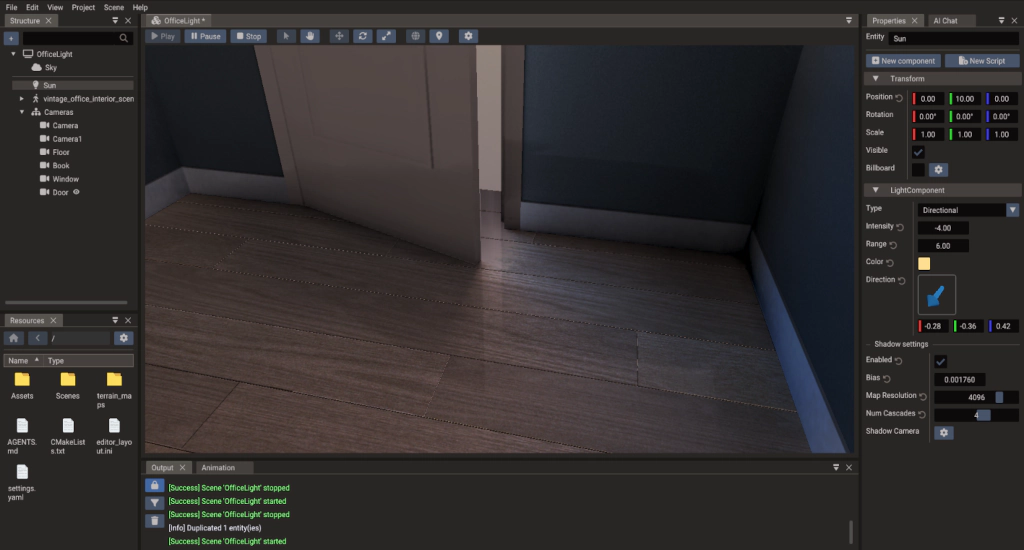
Doriax ships with a full-featured visual editor available on Windows, Linux, and macOS. Key components include:
- Scene hierarchy with inspector and resource management
- 2D tools for sprites, tilemaps, and sprite/tileset slicers
- 3D scene editing with cameras, lighting, models, and play-in-editor mode
- Animation timeline and bone editing for skeletal animation
- Integrated code editor for both Lua and C++
- Custom shader editing — developers can fork and modify built-in shaders (Mesh, UI, Points, Lines, Sky) with live recompilation in the viewport
Rendering, Physics, and Audio
Graphics Pipeline
Doriax supports Physically-Based Rendering (PBR) with a robust feature set:
- Dynamic lights with cascaded shadows
- Sky-driven image-based lighting (IBL)
- Screen-space ambient occlusion (SSAO)
- Fog (linear and atmospheric)
- Planar mirrors
- Sprite sheet animation and particle systems
- Heightmap terrain with clipmap level-of-detail
- GLTF and OBJ model import with skeletal animation, morph targets, and mesh instancing
The engine targets four graphics backends — OpenGL, Vulkan, Metal, and DirectX — enabling cross-platform deployment without rewriting rendering code.
Physics
Physics is handled by two established libraries:
- Box2D for 2D physics (rigid bodies, joints, collision detection)
- Jolt Physics for 3D — chosen by the creator for being “newer and better” than Bullet, as noted in the Reddit AMA
Audio
Spatial 3D audio is provided by SoLoud, a lightweight, open-source audio engine supporting positional sound and effects, as reported by Brazilian game-development outlet Drops de Jogos.
Cross-Platform Reach
Doriax follows a “write once, deploy anywhere” philosophy:
| Editor | Target Platforms | Graphics APIs |
|---|---|---|
| Windows, Linux, macOS | Windows, Linux, macOS, Android, iOS, HTML5 | OpenGL, Vulkan, Metal, DirectX |
The shader-aware export pipeline compiles scenes, assets, scripts, and shaders for each target platform, with cross-platform shader translation handled automatically.
Licensing and Open-Source Model
Doriax is released under the MIT License, making it free for both personal and commercial use with no royalties or revenue-sharing requirements. The project is hosted on GitHub with its source code fully open. As of August 2026, the repository shows over 640 stars, 68 forks, and three listed contributors: Eduardo Doria, Caio Tavares, and Ikko Eltociear Ashimine.
Development is supported through GitHub Sponsors and Patreon, with the creator noting that contributions help sustain infrastructure and accelerate improvements.
Current Status and Roadmap
The project is in an active but pre-stable phase. Public builds are pulled directly from the main branch and are not considered stable releases — users should expect bugs, incomplete features, and breaking changes. Documentation is still under construction, and the creator has acknowledged the need for more tutorials and polished example projects.
The roadmap includes:
- Stabilization of the core editor and runtime
- Expanded documentation and video tutorials
- Larger example projects to showcase the engine’s capabilities at scale
- Continued refinement of the AI assistant and shader tooling
A small test game — a quirky “ice pee” particle demo — is available as an early showcase of the engine’s capabilities.
How Doriax Positions Itself in the Engine Landscape
When asked why a developer might choose Doriax over established engines like Godot, Unity, or Unreal, the creator’s answer is straightforward: performance and output size. The engine is designed to produce smaller executables and achieve higher frame rates on the same hardware, thanks to its lean ECS core and data-oriented architecture. The creator acknowledges that engines like Godot reached their current state after years of criticism and improvement, and expresses a willingness to listen to user feedback.
A hands-on review at GameFromScratch described Doriax as “a shockingly robust 2D/3D game engine” that punches above its weight for a project still in early development, praising its integrated editor, comprehensive feature set, and MIT licensing model.
Getting Started
The engine is available on Windows, Linux and MacOS, with a pre-compiled executable/binary. To grab it, just head to their download page.
Alternatively, you may also compile the engine yourself:
git clone https://github.com/doriaxengine/doriax.git
cd doriax
cmake -S . -B build -DCMAKE_BUILD_TYPE=Release
cmake --build build --config Release
Community support is centered on a Discord server, where users can ask questions, report issues, and share feedback directly with the creator. They also have a github, and social media like Twitter.
A Brazilian Engine on the Global Stage
Though its creator is Brazilian, Doriax is positioned as a global, English-first project with documentation and community channels in English. Its combination of MIT licensing, and cross-platform reach makes it one to watch as the indie engine landscape continues to diversify — and as a solo developer’s decade-long vision finally reaches the broader community.
 Buy me a Ko-fi
Support this blog ❤️