
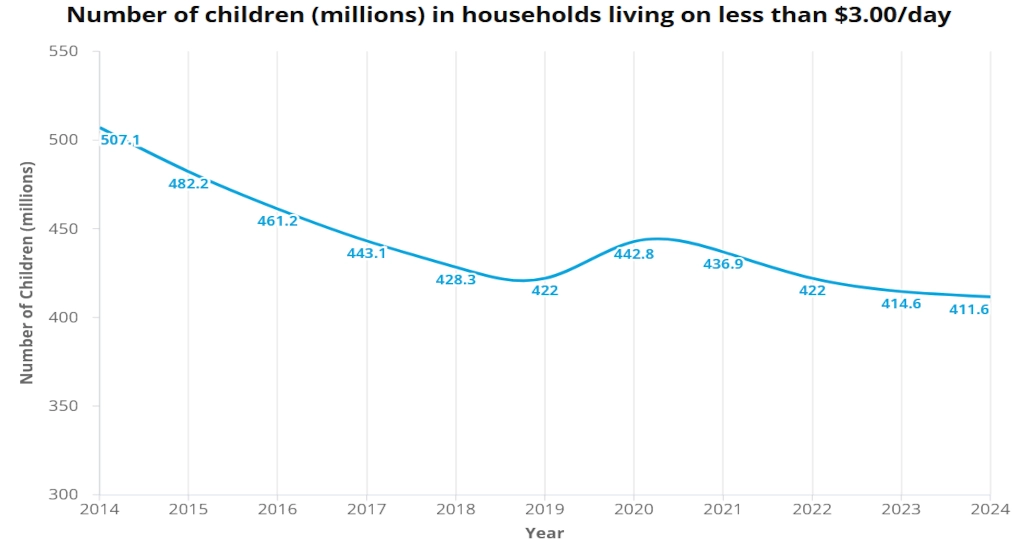
In the past decade, the world has witnessed a gradual yet significant decrease in the number of children living in extreme poverty, according to a recent joint analysis by the World Bank and UNICEF.
The study, based on the latest data from the World Bank’s Poverty and Inequality Platform and updated global poverty lines, showed massive improvements in certain regions, with others remaining mostly stagnant.
Measuring Poverty with New Benchmarks
To capture a more accurate representation of global poverty, the analysis employs two updated poverty lines. The first threshold is set at $3.00 per day, adjusted for 2021 purchasing power parity (PPP), identifying those in absolute monetary poverty according to the standards of the world’s poorest nations. The second, more stringent line of $8.30 per day (2021 PPP) is designed to assess poverty in countries where the cost of living and expectations for basic well-being are higher.
Global Trends: A Mixed Bag of Success and Setbacks
As of 2024, approximately 412 million children—over 19% of the global child population—are surviving on less than $3.00 per day. This figure marks a significant improvement from the 507 million children, or 24% of the global child population, living in such conditions in 2014. Despite a temporary increase in 2020 due to the COVID-19 pandemic, nearly 100 million fewer children are now in extreme poverty.
However, when viewed through the $8.30 per day lens, the situation is more concerning. Approximately 1.4 billion children, nearly 66% of the global child population, are considered poor. Although this represents an improvement from 73% in 2014, it highlights the extensive work still required to address broader economic vulnerabilities.
Regional Disparities: A Tale of Uneven Progress
Sub-Saharan Africa continues to struggle with the highest rates of extreme child poverty. In 2024, over 52% of children live on less than $3.00 per day, a figure that remains virtually unchanged since 2014. The region is home to three out of four children in extreme poverty globally, underscoring the impact of rapid population growth, fragility, conflict, and climate vulnerability.
Conversely, South Asia has shown remarkable improvement, with extreme child poverty rates plummeting from about 25% in 2014 to just over 8% in 2024. India’s efforts have been pivotal, reducing its extreme child poverty rate from over 25% to just over 5% between 2011 and 2022. Nonetheless, at the $8.30/day level, 85% of children in South Asia remain in poverty, indicating widespread economic vulnerability.
In East Asia and the Pacific, extreme child poverty has dropped from nearly 13% to 4%, with Indonesia leading the charge by lifting nearly 20 million children out of poverty, reducing its extreme child poverty rate by 73% between 2015 and 2024. Even with these gains, the region’s child poverty rate at the $8.30/day level is still high, falling from 59% to 37%.
Latin America and the Caribbean have maintained relatively low levels of extreme child poverty, with a rate of just under 8% in 2024, down from over 10% in 2014. However, over 41% of children still live below the $8.30/day threshold, revealing persistent inequality.
In Europe and Central Asia, child poverty at the $8.30/day level has declined from about 19% to just over 10%, reflecting positive strides in the region.
The Middle East and North Africa, however, have seen a troubling reversal, with extreme child poverty almost doubling from 7% in 2014 to over 13% in 2024, largely due to the crisis in Yemen. The $8.30/day poverty rate has remained stagnant at around 60%, highlighting the region’s ongoing struggles.
National Highlights: Success Stories and Challenges
Certain countries have made noteworthy advancements in reducing child poverty. Indonesia, for instance, saw a dramatic 73% fall in extreme child poverty between 2015 and 2024. Similarly, Georgia experienced a halving of extreme child poverty from 2014 to 2023, and Mexico observed a nearly 44% reduction between 2016 and 2022. However, progress was not universal, with increases in child poverty noted in conflict-affected nations.
A Call to Action
The data is unequivocal: reducing child poverty is achievable, but it demands focused, sustained, and inclusive efforts. While the world has made strides, the pace of progress for children lags behind that for adults, and regional disparities are stark. Prioritizing children in global poverty reduction strategies is not only a moral duty but also a prudent investment in our shared future. The analysis calls for an increased and sustained commitment to ending child poverty, emphasizing that such action is essential to ensure no child is left behind in the global march towards prosperity.
Source: World Bank
Like my content? Support me with a tip!