
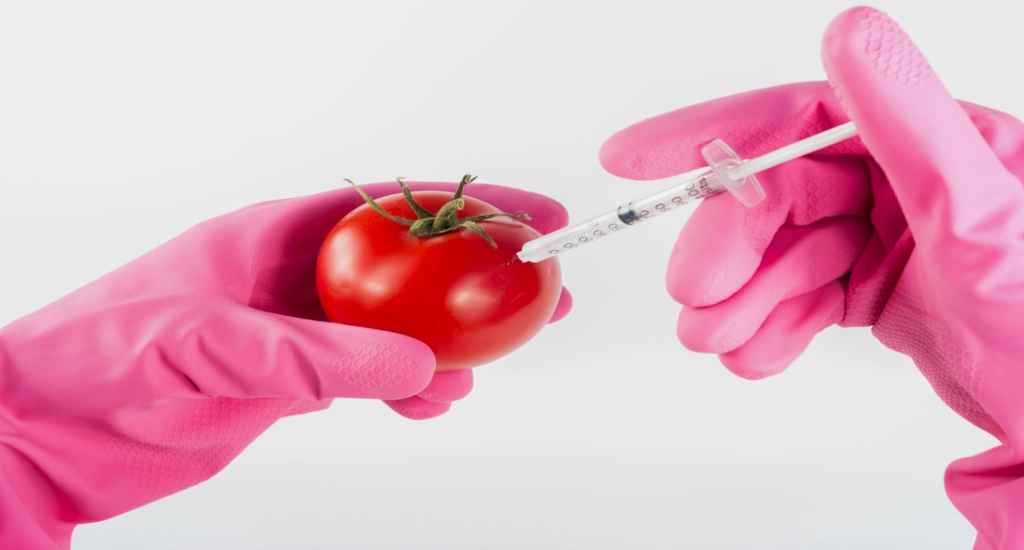
Genetically modified organisms, or GMOs, are plants or animals whose DNA scientists have changed. This change gives the organism a new trait, such as resistance to an insect or better tolerance to drought. Scientists can add a whole new gene from another organism or make small edits inside the organism’s own DNA. New tools like CRISPR let researchers make very precise edits to a tiny piece of DNA.
Scientists make GMOs for several practical reasons. Farmers want crops that lose less to pests and disease. In some places, crops that use less water or grow on poor soil can help feed more people. Companies and researchers also create GMOs to add nutrients to food, as with rice that makes more vitamin A. Other goals include making crops easier to harvest or more stable in storage and transport.
CRISPR?
CRISPR is a tool that scientists use to change the DNA of living things. Think of it like a very precise pair of scissors that can cut DNA in exactly the right spot. After cutting, scientists can remove, add, or change small parts of the DNA. This lets them give the organism new traits or improve existing ones. CRISPR is special because it’s easier to use and more accurate than older methods, making it a popular choice for genetic modification.
It’s not just for plants; CRISPR can also be used to study and potentially treat diseases in humans. Because it’s so powerful and versatile, CRISPR has become an important part of modern science and technology. However, like any tool, it’s crucial that scientists use CRISPR responsibly and consider its impacts on health, the environment, and society.
Examples and benefits
You will hear names like Bt crops, herbicide-resistant varieties, and Golden Rice. Bt crops make a protein that kills certain insect pests, so farmers may use fewer insect sprays. Herbicide-resistant crops survive a specific weed killer, which makes weed control easier for some farmers. Golden Rice was designed to provide extra vitamin A where diets lack it. Each example shows different reasons for genetic change and different results in the field.
There are clear benefits to using GMOs. When a crop resists a damaging insect, harvests can be bigger. Higher yields mean more food from the same land. In some cases, GM traits have reduced the need for certain insecticides, helping farm workers and nearby wildlife. When nutrition is improved in a staple crop, it can help public health in poor regions.
Health and environmental concerns
At the same time, GMOs raise real concerns. On the health side, major science groups say that approved GM foods on the market are not more dangerous than similar non-GM foods. Still, every new GMO should be tested before it becomes widely available. Safety checks look for possible allergies, toxicity, and unexpected changes in the food.
Environmental concerns come up often. Some GM crops have allowed farmers to use fewer insecticides, but other traits have led to more use of particular herbicides. Over time, weeds and insects can evolve resistance. This makes some chemicals less useful and can push farmers to use different or stronger methods. How a GMO affects the environment depends a lot on which trait it has and how farmers manage their land.
Economic, social, and regulatory issues
There are also economic and social worries. A small number of large companies sell many commercial GMO seeds and related inputs. This can concentrate power and choice in a few hands, sometimes raising seed costs for farmers. People also raise ethical questions about changing natural organisms and want clear labels on food so they can choose what to buy. Those are social and political issues, not purely scientific ones.
Governments and scientific agencies try to manage risks with testing and rules. New GMOs usually go through studies before approval. Some countries also require monitoring after approval to spot long-term effects. Rules and oversight vary by country, so a GMO allowed in one place may face stricter review in another.
How to think about GMOs
A useful way to think about GMOs is to see them as tools. Tools can help or harm depending on how they are used. When science is strong, regulation is clear, and farmers use diverse practices, some GMOs bring important benefits. When testing is weak, farming relies on a single tactic, or markets are controlled by a few firms, problems are more likely.
In short, GMOs are not simply good or bad. The safety and impact of each GMO should be judged case by case. Good science, fair rules, and careful farming practices make the outcomes better.
Like my content? Support me with a tip!