
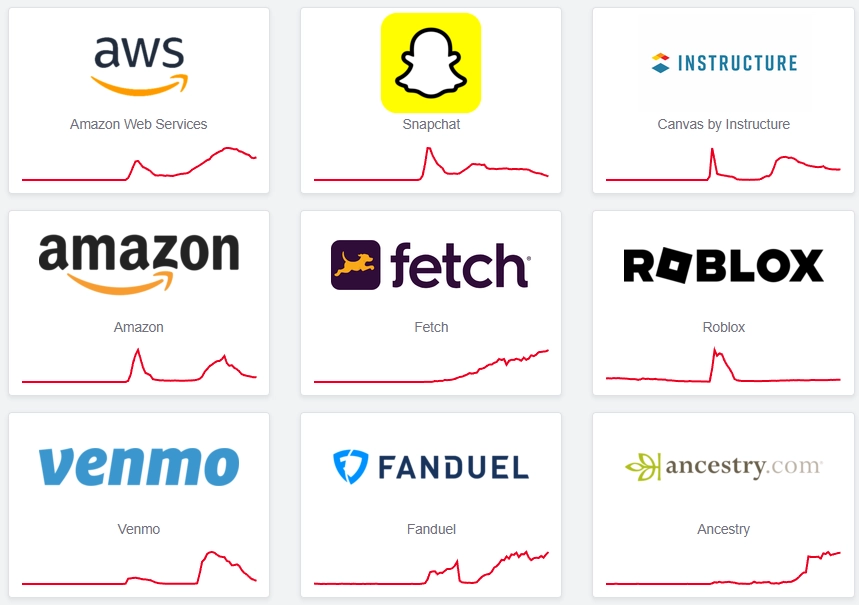
Earlier today, AWS(Amazon Web Services) had a catastrophic failure starting around 4:11(BRST) and ending at 7:30, mostly on their US-EAST-1, where some of their main servers are located.
Within those 3 hours, over 500 apps showed problems, causing an estimated $5 Billion lost revenue. While most services have already recovered, users at Downdetector continue reporting issues at the time of writing, implying an even greater impact.
According to AWS, the issue was related to DNS resolution to their DynamoDB API endpoint. It was then followed by EC2 instances experiencing high error rates. Both seem to be mostly resolved.
The big cloud
AWS is the most popular digita platform for hosting web services there is. The company, made in 2006 as part of amazon, is responsible for about 30% of today’s cloud market, followed by Azure’s 20% and Google’s 12%. Together, they account for over 60% of the global cloud market.
And this is cause for concern.
On one hand, having your services hosted by a giant corporation with years of experience and massive infrastructure is a great thing. On the other hand, however, having so much of our infrastructure inside 3 companies makes the web as a whole a fragile ecosystem.
Having so much data in so few places makes them a prime target for criminals and state agents and, as seen time and again, no matter how much is invested in cybersecurity, no service is 100% safe.
Other than security, AWS has such complex and vast systems that outages are basically a yearly guarantee. Some of the most drastic examples include:
- February 28, 2017 — S3 US-EAST-1 outage (human error) Amazon Web Services, Inc.
- April 21–24, 2011 — EBS outage in US-East (stuck volumes) InfoQ
- December 7, 2021 — US-East-1 network device impairment thousandeyes.com
- November 25, 2020 — Kinesis outage (thanksgiving period) Arpio
- October 20, 2025 — Global outage originating in US-East-1 Reuters
Then what?
If not big cloud, then what should people use? Well this is where we go from facts to my opinion.
In today’s world, as I’ve mentioned in a previous article “is AWS worth it? No”, there are two options which are better for most users: Smaller, local providers and Self hosting.
Smaller providers, by which I don’t mean micro ones that mainly focus on websites, are best suited for any small and medium-sized projects. They normally have humans doing tech and financial support instead of AI, datacenters of decent size, infrastructure and experience enough and better prices as the market is quite competitive. On top of that, those are less likely to be targeted by bad actors.
For large projects, self hosting is essential. Your project shouldn’t rely on big providers, because that adds an extra point of failure: not only can your developers make mistakes, but now the ones at your cloud providers can as well. Not to mention, making use of cloud providers can add a massive cost, specially long term.
As a side point, it’s also important to note that the U.S. can and will steal any and all data from your project if they so wish, no matter where your company is located, as long as the servers are hosted in U.S. soil, under the cloud act.
Like my content? Support me with a tip!