
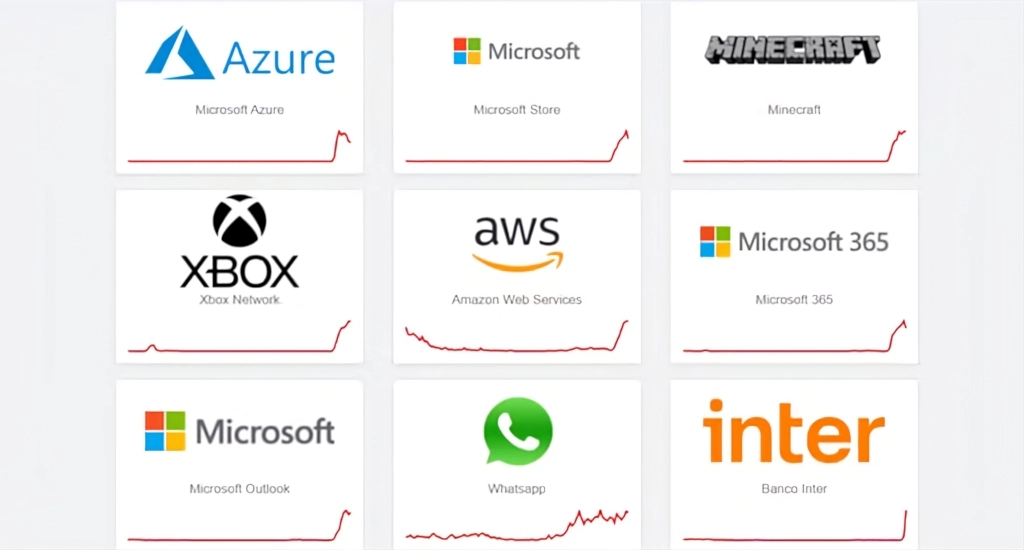
The Microsoft Azure cloud experienced a global instability on Wednesday, October 29, interrupting service for thousands of users of Microsoft 365, Minecraft, Xbox Live and a range of business applications. The incident comes just nine days after a major Amazon Web Services (AWS) outage — a sequence of events that has renewed concerns about how much of the internet depends on a handful of large cloud providers. Below are the key details.
How many users were affected?
Monitoring site Downdetector showed 18,000 reports of problems affecting multiple Microsoft services at about 14:40 Brasília time. Individual service tallies were substantially larger:
- Microsoft 365: more than 9,000 reports.
- Microsoft Azure: over 16,600 reports of instability.
- Xbox Live: players reported being unable to connect to servers or form parties.
- Minecraft: players could not join online servers.
- Microsoft Copilot: the AI assistant was unavailable to some users.
- Azure Portal: administrators lost access to the management console.
- Outlook: users experienced add-in failures and networking issues.
Other Microsoft-linked apps and enterprise customers on Azure were also hit. Reported disruptions touched rail operators in the Netherlands, U.S. carriers Alaska Airlines and Hawaiian Airlines, and major retailers including Starbucks, Kroger and Costco.
What caused the Azure problems?
Microsoft’s Azure status page attributed the outage to issues with DNS (Domain Name System) and with Azure Front Door, the company’s edge and traffic-routing service.
DNS is the internet’s address directory — it converts human-readable domain names into IP addresses. When DNS malfunctions, browsers and applications cannot locate the right servers, causing wide-reaching connection failures.
In a status update, Microsoft said it was investigating an Azure Portal issue that prevented some customers from accessing the portal. The company indicated it suspects an inadvertent configuration change triggered the disruption and said it was blocking further configuration edits to Azure Front Door while attempting to roll systems back to the last known good configuration.
Azure vs. AWS: shared weak points
The Azure incident occurred days after AWS suffered a substantial outage on October 20 that was also linked to DNS problems. That AWS event, centered in the US-East-1 (Northern Virginia) region, left the data center unstable for more than ten hours and knocked out over 500 applications — impacting services such as Mercado Libre, iFood, PicPay, Roblox, Duolingo, Canva and Fortnite.
On October 20, AWS reported fresh instability in the same US-East-1 region, with more than 15,000 reports on Downdetector. The near-simultaneous troubles at two leading cloud providers underline shared vulnerabilities in core internet services.
Why market concentration matters
Amazon Web Services, Microsoft Azure and Google Cloud together dominate a large portion of the global cloud market. Estimates commonly put AWS at roughly 30% and Azure at about 25%, with the three largest providers controlling more than 65% of the market. That market concentration lets companies scale rapidly and cheaply, but it also centralizes systemic risk: when a major provider experiences a failure, the ripple effects can hit many services and industries at once.
History shows the stakes
This episode is not unique. In July 2024, a faulty update from cybersecurity vendor CrowdStrike disrupted systems worldwide and led to the cancellation of thousands of flights — an example of how a single software or configuration error can propagate across sectors and cause substantial economic damage.
9 days ago, AWS also experience an hours-long failure which is estimated to have caused billions in losses.
Source: Techtudo
Like my content? Support me with a tip!