

Researchers from UFPR employ nanoarchitecture to develop devices that, besides being environmentally less costly than lithium, are flexible, transparent, and functional in aqueous environments, expanding their application possibilities.
Batteries are an integral part of our daily lives, powering everything from cell phones, cars, and laptops to pacemakers, digital cameras, and more. A myriad of electronic communication devices, computing gadgets, transportation vehicles, and even health-related items rely on batteries for their operation.
Conventional batteries are predominantly made of lithium, a lightweight metal with a high energy storage capacity, primarily sourced from saltwater lakes or pegmatites—igneous rocks rich in rare elements. Despite its efficiency, lithium poses significant environmental and safety risks. As a result, scientists are exploring alternative elements like sodium and potassium, which are more abundant and cheaper to extract.
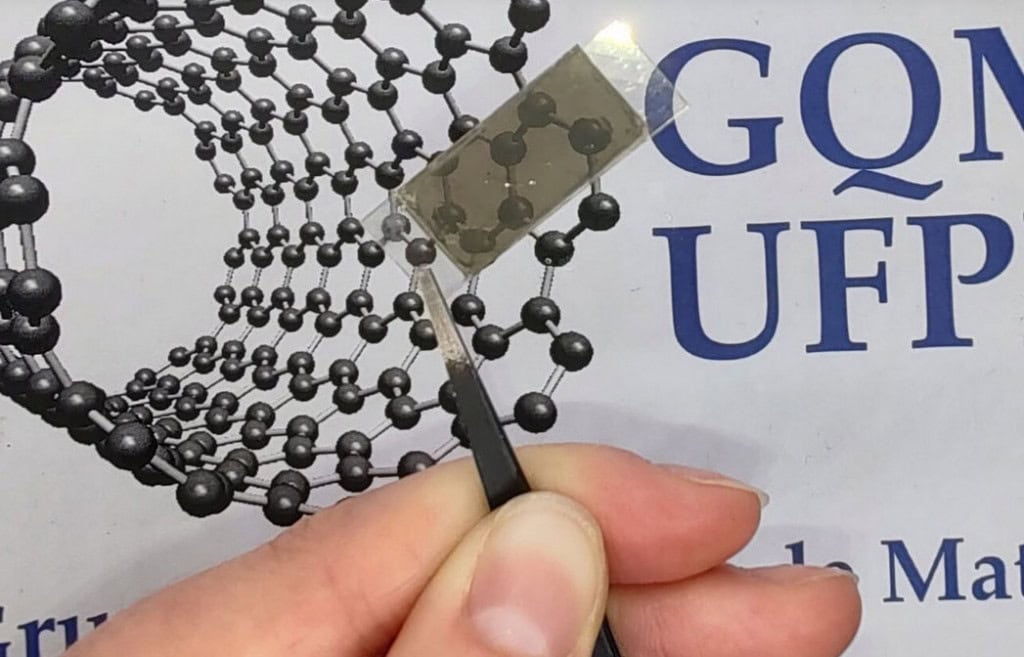
Leading the charge in sodium-ion battery research at the Federal University of Paraná (UFPR) is Professor Aldo José Gorgatti Zarbin, who has dedicated 28 years to the field. Alongside researchers from his coordinating lab, the Materials Chemistry Group (GQM), Zarbin has created a functional battery prototype from table salt sodium. This prototype uniquely combines flexibility, transparency, and the ability to operate in an aqueous environment, eliminating the risk of explosions.
The study was recently featured on the cover of the Royal Society of Chemistry’s Sustainable Energy & Fuels journal. It also earned Zarbin the Paraná Science and Technology Award, recognizing his contribution to the state’s scientific and technological production.
Motivated by the quest for a greener energy matrix and innovative battery applications, Zarbin highlights the importance of batteries in the transition to clean energy. “Not long ago, we had COP 30 discussing clean energy and the critical need to eliminate fossil fuels to stop emitting carbon dioxide,” Zarbin states.
“One way to harness energy is through solar power. But what about nighttime when there’s no sun? We need batteries to store that energy, which is why they are crucial in the process of decarbonization and clean energy.”
Lithium is scarce, primarily found in Chile, Australia, Argentina, and China, and its extraction is fraught with environmental damage and geopolitical tensions. In contrast, sodium is abundant, affordable, and globally distributed, with seawater extraction being less environmentally impactful.
However, simply replacing lithium with sodium isn’t straightforward. The challenge lies in finding materials that can store and release sodium ions as efficiently as lithium. To tackle this, Zarbin’s lab employed nanoarchitecture techniques to develop a combination of three different nanoscale materials suitable for use as electrodes in sodium-ion batteries.
“The entire basis of the study is a technology for preparing materials in the form of thin films, fully developed in my lab. This means we can create a material with a very thin thickness, just a few nanometers. We can deposit this material on any surface, which is key to achieving the properties we have.”
– Zarbin
These sodium-ion batteries not only function but also boast a combination of unique characteristics. Their flexibility allows them to bend and fold without losing functionality, opening up possibilities for wearable electronics and health monitoring devices. “You could place a device on clothing, for instance, to monitor someone’s glucose levels or heart rate, providing in-situ tracking linked to the wearer’s attire. It needs to be foldable, just like our clothes. This technology could be applied to any wearable device,” Zarbin suggests.
The transparency of these batteries, achieved through thin-film technology, enables their use in systems requiring light passage, such as solar cells and smart windows that automatically adjust light and heat intake.
Finally, the development of an aqueous sodium-ion battery significantly enhances safety by eliminating the risk of flammability associated with the toxic and flammable electrolytes in lithium batteries.
“In essence, our invention offers a set of technical and economic advantages that distinguish it from existing technologies: it is safe, ecological, low-cost, lightweight, flexible, and transparent, combining sustainability with high performance.”
– Maria Ramos, researcher at UFPR
The team has taken initial steps towards market entry by submitting a patent application for their innovative battery and planning to scale up from laboratory capacity. “Moving forward, we aim to increase the capacity beyond the lab scale,” Zarbin outlines. “There’s a whole engineering phase ahead, involving prototype development, optimization, and assembly to improve performance.”
Maria Ramos adds that after developing a larger prototype, the next ambitious goal is to integrate energy generation and storage in a single device. “The idea is to capture sunlight with a photovoltaic cell, convert it into electricity, and store it directly in a connected battery,” she explains. “This integration offers space-saving, weight reduction, and minimizes energy loss typically encountered when transferring energy between separate devices.”
Source: UFPR
Like my content? Support me with a tip!