
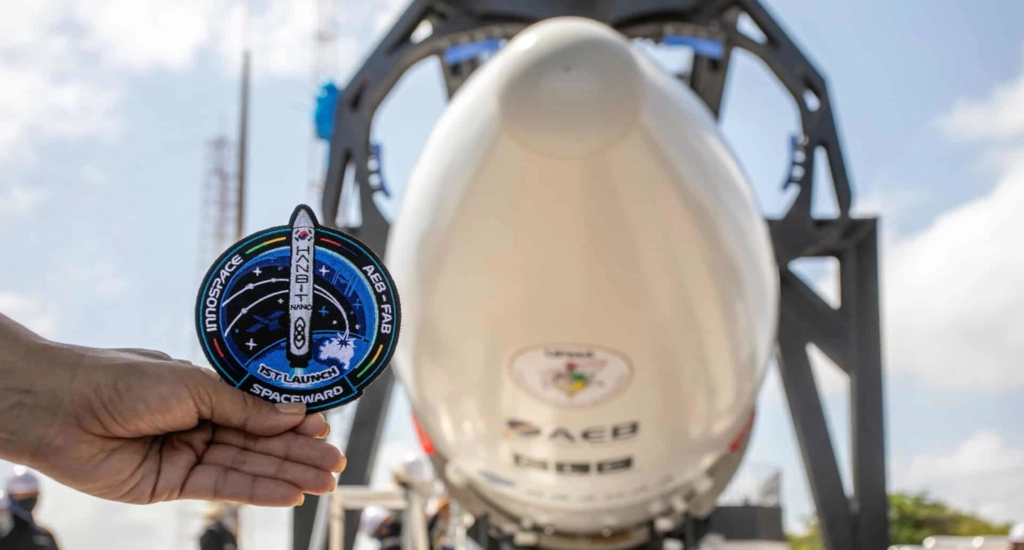
Brazil is on the brink of a significant milestone in its aerospace history with the anticipated first commercial rocket launch from its own territory. Scheduled for December, the groundbreaking mission, known as Operation Spaceward, will launch the South Korean rocket, HANBIT-Nano, from the Alcântara Launch Center in Maranhão, marking Brazil’s debut in the commercial space launch market.
Operation Spaceward is a collaborative effort between the Brazilian Air Force (FAB) and the Brazilian Space Agency (AEB). Beyond the launch itself, this mission serves as a practical test to assess Alcântara’s potential as a commercial spaceport—a concept debated for decades but never realized on an orbital scale.
The launch window is set between December 17th and 22nd, following adjustments to the initial timeline. The HANBIT-Nano rocket, operated by the private South Korean company Innospace, will be under the full coordination of Brazilian authorities, encompassing flight clearance and trajectory monitoring post-launch. This endeavor positions Brazil as a potential player in the global space launch industry.
The HANBIT-Nano rocket, standing at approximately 21 meters in height with a weight of 20 tons and a maximum speed of 30,000 km/h, will carry eight payloads into space, including five satellites and three experiments developed by institutions from Brazil and India. These payloads aim to gather environmental data, conduct in-orbit communication tests, monitor solar phenomena, and validate future technologies for drones, vehicles, and navigation systems.
Rocket Mechanics and Launch Operations
The two-stage HANBIT-Nano rocket is powered by the innovative HyPER hybrid motor, which combines solid and liquid fuel. This propulsion system allows for power adjustments during flight, reducing failure risks and simplifying the technology, making it more cost-effective.
The launch operation is a meticulously timed process:
- The FAB activates the Control Center hours before launch, where teams monitor systems in real-time.
- Critical “GO or NO-GO” decision points occur throughout the countdown.
- Any deviation from expected conditions—weather, sensor readings, or communication issues—automatically halts the launch.
Approximately 400 to 500 professionals, including Brazilian military and civilian personnel alongside South Korean technicians, are involved in the mission.
Alcântara’s Strategic Importance and Future Prospects
Alcântara Launch Center is renowned globally for its advantageous location near the Equator, which minimizes fuel consumption and enhances flight efficiency, offering flexibility in orbital trajectories. However, the facility has been underutilized for decades due to the tragic 2003 explosion of the VLS rocket, which claimed 21 lives and stalled Brazil’s space program, and unresolved land disputes with local quilombola communities, which reached the Inter-American Court of Human Rights.
Recent developments have paved the way for Alcântara’s resurgence:
- The 2019 signing of the Technology Safeguards Agreement with the United States, facilitating the commercial use of the base by companies using American technology.
- A 2024 conciliation agreement that officially recognized quilombola territory and defined the launch center’s area.
The HANBIT-Nano launch now symbolizes not just a space mission, but the beginning of a new era for Brazil in space exploration. This phase could attract investments, generate income, and place Alcântara on the world map of commercial space launches, significantly contributing to Brazil’s aerospace ambitions.
Source: Olhar Digital, FAB
Like my content? Support me with a tip!