
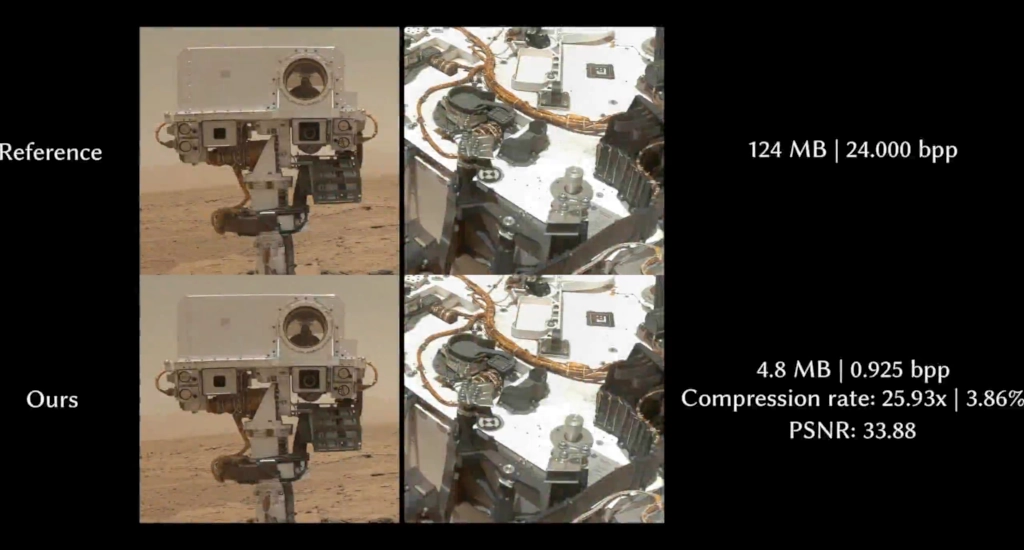
Neural image representations have reshaped how we think about image storage and rendering. They can trade off memory for visual fidelity in clever ways. Yet many of today’s methods either use heavy, slow implicit models or fixed data structures that waste capacity. Image-GS takes a different path: it represents images explicitly as a cloud of colored, anisotropic 2D Gaussians and optimizes them to reconstruct a target image. The result is a practical, content-adaptive format that is both lightweight and fast to decode — suitable for real-time graphics workflows.
Why that matters
Image-GS models an image as a sum of 2D Gaussian “blobs.” Each Gaussian has a position, orientation, scale, and color. Gaussians are placed where the image needs them most. A differentiable renderer converts the Gaussian set into pixels. The system progressively adds Gaussians to fix high-error regions.
Traditional codecs like JPEG tune for general images and often produce blocky artifacts at low bitrates. Modern neural codecs can yield great quality, but many are slow to decode or require expensive networks. Image-GS sits between those extremes. It is explicit and content-aware, and it supports very fast random access. The paper shows strong rate-distortion results, especially on stylized graphics and textures where important features are spatially concentrated.
How Image-GS works
- Initialization guided by image content. The method starts by sampling Gaussian centers more densely where image gradients are strong. This biases capacity to edges and details.
- Parameterization. Each Gaussian stores a 2D mean, rotation, scale, and a color vector. The authors optimize the inverse scale for better numerical stability.
- Tile + top-K rendering. The image is split into tiles. For each tile, only the Gaussians that intersect the tile are considered. For each pixel, only the top-K Gaussians (by contribution) are used and normalized. This keeps decoding cheap and cache-friendly.
- Differentiable renderer and optimization. Gaussian parameters are optimized end-to-end with a differentiable rendering pass. Losses include L1 and SSIM, so the result matches perceptual quality as well as pixel accuracy.
- Progressive, error-guided refinement. During training, Image-GS adds more Gaussians into regions that still show high reconstruction error. This naturally builds a smooth level-of-detail (LOD) hierarchy.
Performance highlights
- Image-GS decodes pixels with only about 0.3K MACs per pixel, an order of magnitude better than some recent neural codecs.
- On a modern GPU (NVIDIA A6000) rendering is extremely fast — the paper reports single-pass renders in a few milliseconds for high resolutions.
- Rate-distortion results outperform a wide set of neural baselines across the tested stylized image set. At ultra-low bitrates, Image-GS even beats JPEG in many cases.
- It also compares favorably against industry texture compressors (BC1, BC7, ASTC) for multi-channel texture stacks.
What it’s especially good for
- Stylized graphics, digital art, and anime. These assets often have localized, high-frequency features. Image-GS allocates Gaussians where they matter.
- Texture compression for real-time rendering. Fast random access and parallel decoding make it GPU-friendly.
- Semantics-aware compression. By seeding Gaussians using saliency maps, Image-GS preserves task-relevant image content for machine vision (e.g., VQA).
- Joint compression + restoration. The Gaussian basis naturally filters out sensor noise and compression artifacts at low budgets, yielding restored outputs without extra post-processing.
Limitations to keep in mind
- Natural, noisy photos are harder. The approach prioritizes larger and semantically important features. It struggles when accurate pixel-level detail is required across the whole image.
- Optimization cost for production. While rendering and decoding are fast, the per-image optimization loop still requires compute. The authors show efficient convergence, but per-image training remains a practical consideration.
- No entropy coding by default. The representation shown avoids entropy coding to keep random access and locality — which is a design choice with trade-offs.
Design choices that make a difference
- Content-adaptive initialization gives faster, better convergence than random starts.
- Top-K normalization reduces compute and acts as a regularizer for better generalization.
- Inverse scale optimization stabilizes gradients and speeds convergence.
- Tile-based assignment preserves data locality, crucial for GPU performance.
Where it could go next
The authors discuss promising extensions: spatially adaptive optimization schemes to recover fine pixel detail, and modeling motion of 2D Gaussians for video or dynamic textures. These directions could make Gaussian-based representations competitive for more general image families and streaming video.
Image-GS revisits a simple but powerful idea: represent images as a set of localized basis functions and let optimization and content adaptivity do the rest. The result is an elegant, explicit image format. It delivers strong compression-quality trade-offs, practically usable decoding costs, and useful properties for graphics pipelines and machine-vision tasks. For applications that value fast random access, graceful LOD control, and compact storage of stylized assets or texture stacks, Image-GS is a compelling new tool.
Source: sdiolatz
Like my content? Support me with a tip!



why dont they bake this into their gpus?
right now, other than image compression, its not the most useful thing but if more uses come out of it? more than likelt it will