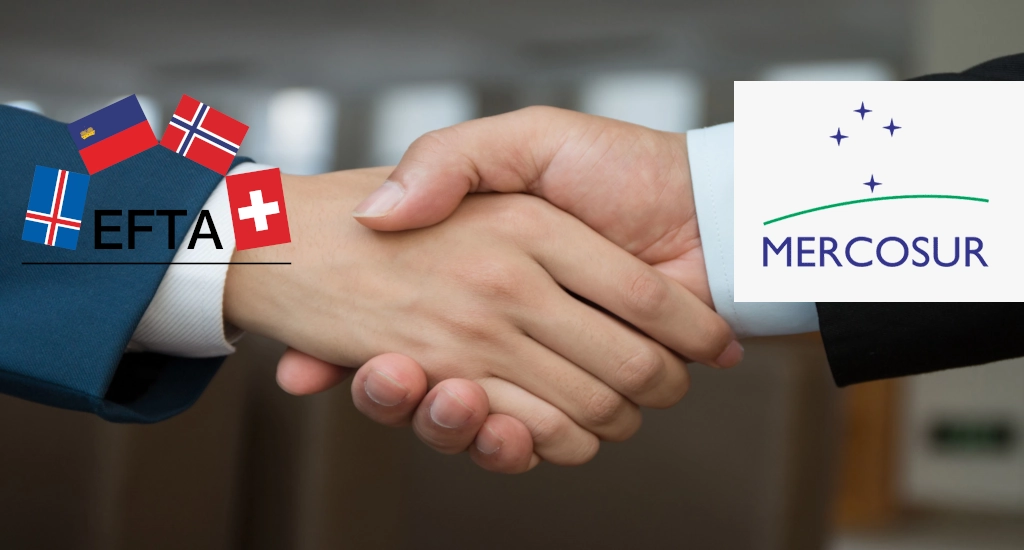
In a major move this week, Mercosur—comprising Brazil, Argentina, Uruguay, Paraguay, and Bolivia—has officially concluded negotiations on a free-trade agreement with the European Free Trade Association (EFTA), a bloc of Switzerland, Norway, Iceland, and Liechtenstein. The deal is poised to be formally announced during the 66th Mercosur Heads of State Summit in Buenos Aires, set for July 3.
Why This Matters
- Trade scope & scale: The agreement spans goods, services, rules of origin, intellectual property, sustainable development, and government procurement—issues carefully negotiated over 12+ rounds since March 2025 in Buenos Aires (efta.int).
- Massive markets opening: It establishes a new free-trade channel between two economically significant blocs—Mercosur representing over 290 million people—and EFTA, which together have a combined GDP exceeding USD 1.4 trillion.
- Strategic alignment: Coming on the heels of Mercosur’s agreement with the EU in late 2024, this deal reinforces the bloc’s Europe-facing economic strategy.
Key Negotiation Highlights
Negotiators tackled sensitive chapters including:
- Environmental protocols: EFTA insisted on stronger environmental safeguards. While Chile noted progress, the pact includes robust climate and sustainability commitments.
- Government procurement: Brazil in particular pushed for greater flexibility in procurement rules to support its domestic industrial policies .
- Rules of origin: Defined to ensure genuine production links and avoid circumvention, though EFTA flagged the complexity of cross-border sourcing—particularly in Switzerland, Norway, and Liechtenstein.
Next Steps
- Official signing: Expected at the Mercosur summit on July 2–3 in Buenos Aires, where the vice president of Switzerland, Guy Parmelin, is expected to be present for the announcement.
- Legal & parliamentary approval: Following the signature, each member country must undergo legal review, internal translations, and ratification. As seen in the Mercosur–EU process, this could span months to years.
Broader Context
This deal forms part of a broader strategic shift: with rising protectionism—highlighted by past U.S. tariffs—and Mercosur’s ambition to diversify export markets, these agreements signal a concerted push toward deeper economic integration with Europe.
Bottom line: The Mercosur–EFTA free-trade agreement marks a significant breakthrough in intercontinental trade cooperation. If swiftly ratified, it stands to unlock enhanced access across a major South American and European trade corridor—balancing economic opportunity with sustainability and national industrial interests.
Source: Metropoles
Like my content? Support me with a tip!