

The Diário Oficial, Brazil’s official gazette, published today the Decree No. 12.797, signed by President Luiz Inácio Lula da Silva, which formalizes the national minimum wage increase effective as of January 1st, 2026.
With this change, the minimum wage will rise from R$ 1,518 to R$ 1,621, marking an increase of R$ 103(7%) compared to the current minimum wage.
Individuals receiving the minimum wage or benefits tied to this value, such as unemployment insurance and the Continuous Provision Benefit (BPC), will receive the adjusted amount at the beginning of February.
Below, we explain how the minimum wage operates, the rule for its adjustment, and the impact of this change on the Brazilian economy.
How Does the Minimum Wage Work in Brazil?
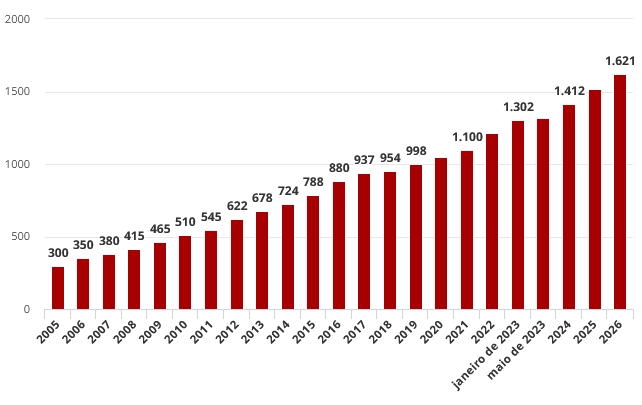
The minimum wage has grown over 5 times in 20 years. According to the Brazilian Constitution, its value must be:
“nationally unified and capable of meeting the basic vital needs of a worker and their family, including housing, food, education, health, leisure, clothing, hygiene, transportation, and social security, with periodic adjustments to preserve its purchasing power, and it is forbidden to link it for any purpose.”
The DIEESE (Inter-Union Department of Statistics and Socioeconomic Studies) reported in a technical note released in January that the minimum wage serves as a reference for 59.9 million people in Brazil.
Government’s Approach to the Wage Increase
If the government only followed the constitutional rule of adjusting the wage by inflation, it could have increased the minimum wage from the current R$ 1,518 to approximately R$ 1,582. This calculation considers the 12-month inflation rate up to November, which stood at 4.18%.
However, President Lula promised during his campaign to resume the “minimum wage appreciation policy,” meaning increases beyond inflation. In 2023, Congress approved a provisional measure by Lula that included this mechanism. According to the new rule, the minimum wage adjustment considers:
- Inflation measured by the National Consumer Price Index (INPC) up to November, as per the Constitution.
- The real growth index of the Gross Domestic Product (GDP) from the previous two years.
Following this rule, the minimum wage would have risen based on last year’s inflation of 4.18% and the GDP growth of 2024 (3.4%), pushing it to R$ 1,636.
Nevertheless, a law passed in December of the previous year restricts the real increase (above inflation) of the minimum wage to 2.5% due to the fiscal framework’s spending cap. Consequently, the adjustment considers the 12-month inflation rate up to November (4.18%) plus a 2.5% real increase (limited GDP growth), resulting in a minimum wage of R$ 1,621 for 2026.
Economic Impact
The minimum wage increase has both direct and indirect impacts on the economy, including raising the average salary of Brazilians and boosting consumer purchasing power. Some economists argue that to prevent further growth of public debt and consequently higher interest rates for the productive sector, the minimum pension benefits should no longer be tied to the minimum wage and should instead be adjusted only for inflation.
Source: Globo
Like my content? Support me with a tip!