
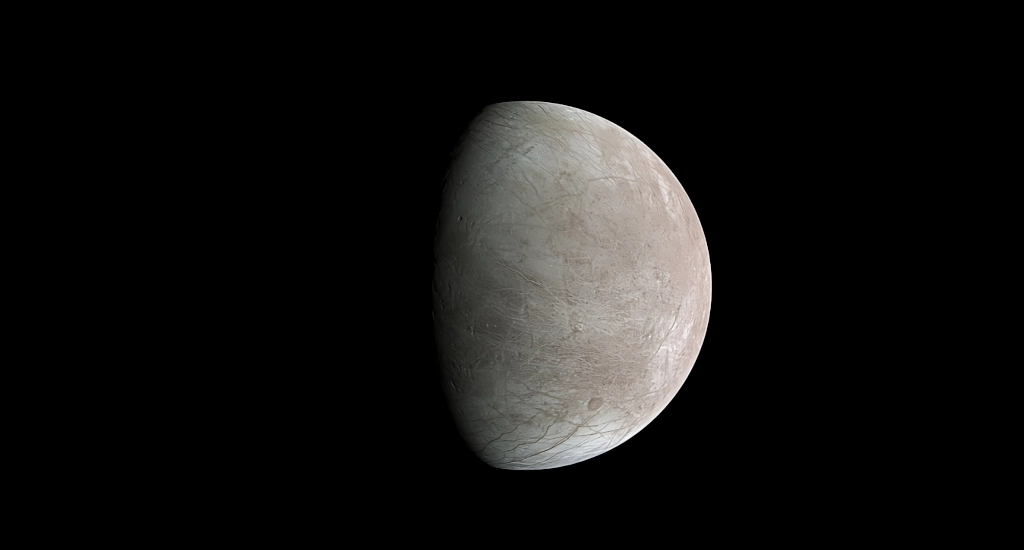
NASA’s Europa Clipper mission has successfully deployed two key scientific instruments, marking another milestone in its journey toward Jupiter’s moon Europa. The spacecraft, launched in October, is on a nearly 3-billion-kilometer voyage to study the icy moon, believed to harbor an ocean beneath its surface.
Following the deployment of its solar panels, the spacecraft extended the magnetometer boom and several antennas essential for its radar system. The magnetometer, an 8.5-meter-long structure resembling a spear, will measure Europa’s magnetic field upon arrival, providing insights into the moon’s subsurface ocean.
The radar system, which will probe beneath Europa’s icy crust, features four high-frequency antennas measuring 17.6 meters in length and eight smaller antennas sensitive to higher frequencies, each 2.76 meters long.
“This is an exciting moment, having these critical deployments completed,” said Jordan Evans, the mission’s project manager. “The team is focusing on understanding small, intriguing details in the data, which helps deepen our knowledge of spacecraft behavior.”
They have plans to test and deploy seven more instruments in December and January while monitoring the spacecraft’s systems.
Exploring Europa: A Moon of Mystery and Promise
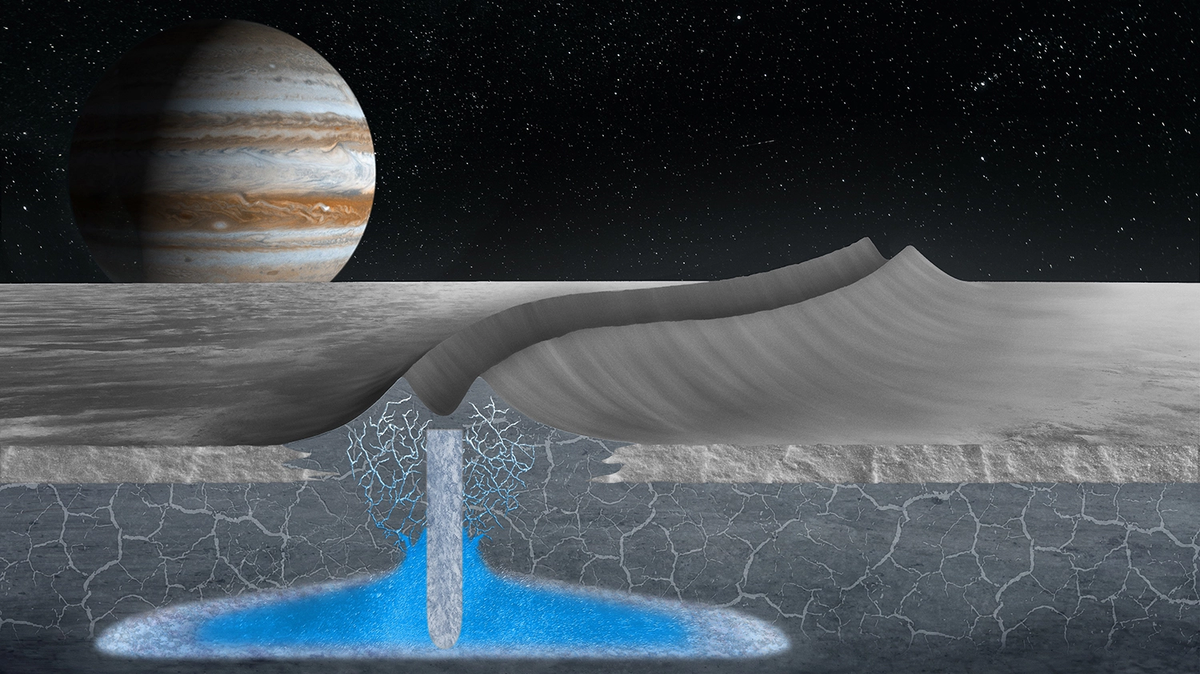
Europa, one of Jupiter’s four largest moons, has intrigued scientists for decades. Slightly smaller than Earth’s moon, Europa is covered in a thick crust of ice that reflects sunlight, giving it a bright, shiny appearance. Beneath this icy shell lies a hidden ocean, potentially twice the volume of all Earth’s oceans combined.
The Europa Clipper mission aims to uncover the secrets of this enigmatic world. By flying close to Europa nearly 50 times, the spacecraft will use its advanced instruments to study the moon’s surface, composition, and subsurface features. Scientists hope to determine whether Europa’s ocean contains the necessary ingredients to support microbial life.
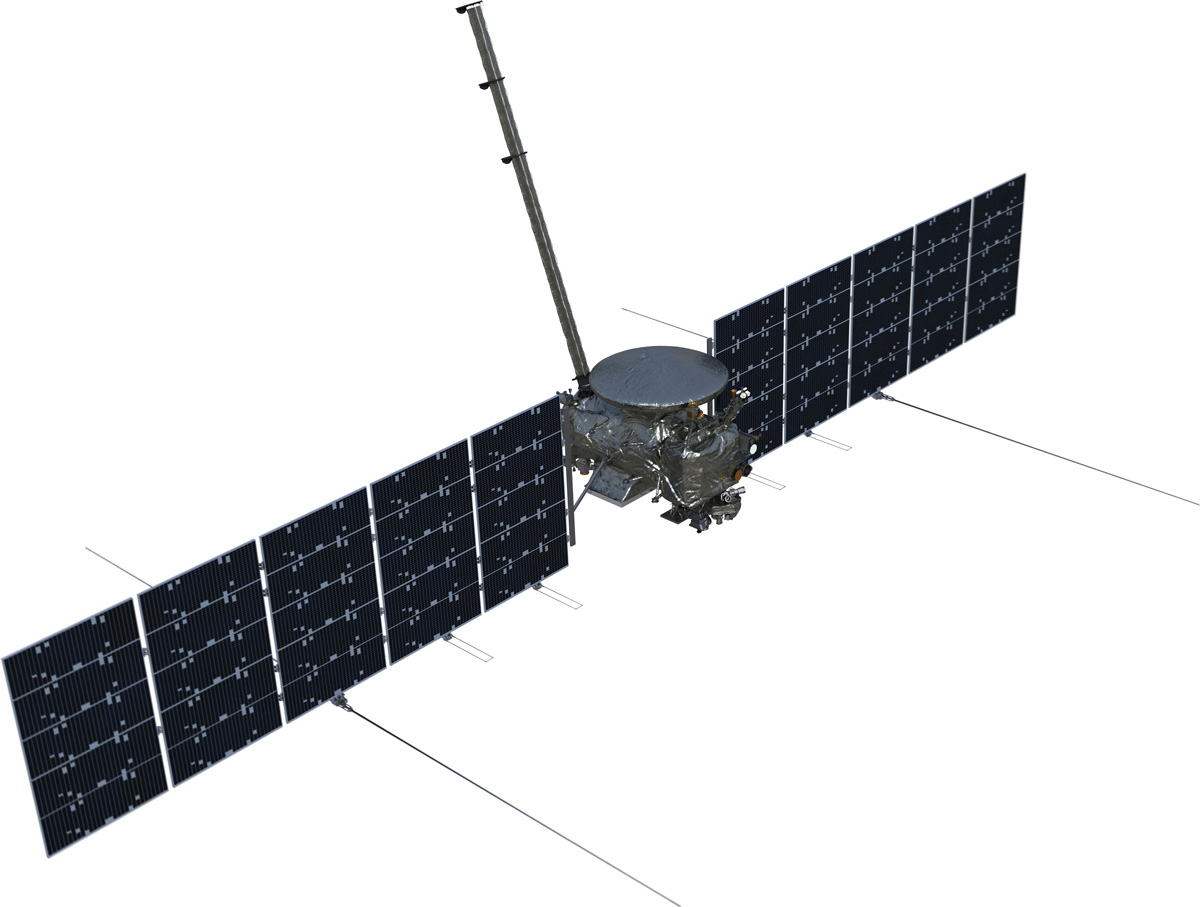
Europa Clipper’s instruments are designed to answer critical questions. The magnetometer will measure variations in the moon’s magnetic field, which could reveal the depth and salinity of its ocean. Meanwhile, the radar system will penetrate Europa’s icy crust to map its structure and search for pockets of water.
Europa’s potential to harbor life has made it a top priority for astrobiologists. By unlocking the moon’s mysteries, Europa Clipper could not only expand our understanding of the solar system but also bring us closer to answering the age-old question: Are we alone in the universe?
As NASA’s largest probe to date, Europa Clipper is set to reach Jupiter between 2030 and 2031. It will conduct nearly 50 flybys of Europa, collecting data to determine whether the moon’s ocean could support life as we know it.
Source: NASA
Like my content? Support me with a tip!