
Brazil has been utilizing optical fiber to enhance telecommunications for nearly half a century, primarily for high-speed data transmission via light. But now, Brazilian researchers are exploring a new function for optical fibers: transmitting electrical power. This innovative project, led by scientists at the National Institute of Telecommunications (Inatel), positions Brazil alongside Spain and Japan in pioneering this cutting-edge technology.
The initiative, prompted by aerospace giant Embraer, aims to use optical fibers to make aircraft lighter, potentially reducing airline ticket prices. The researchers predict that future aircraft will incorporate this technology, with its broader application in telecommunications expected within five years.
“Just before the pandemic, Embraer contacted us to begin studying the technology for power transmission via optical fiber,” explained Arismar Cerqueira Sodré Junior, coordinator of research at Inatel’s WOCA (Wireless and Optical Convergent Access) Laboratory.

The idea is to replace traditional copper cables with optical fibers for internal electrical transmission in airplanes. “An aircraft can contain up to a ton of copper cabling. Fuel costs are high; every kilogram adds to the expense,” said Sodré. Reducing weight would lower costs for airlines and potentially impact ticket prices.
To illustrate, Sodré referenced the “olive story” of American Airlines, where former president Bob Crandall saved $40,000 annually by reducing the number of olives in salads served on flights. If removing a 23-gram fruit can lead to significant savings, imagine the impact of eliminating tons of copper.
Post-pandemic, cost-reduction solutions have become even more appealing to the aviation industry, which was severely impacted by social distancing measures and border closures.
How Optical Fiber Transmits Electrical Power
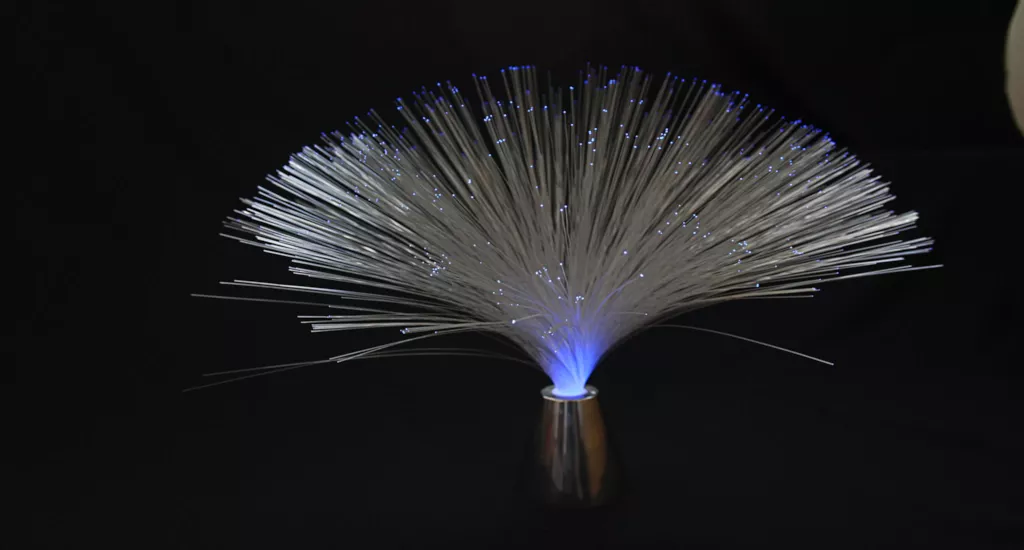
Optical fibers traditionally transmit data by converting information into light at one end and decoding it at the other. This high-speed data transmission is possible because optical fibers are made of glass and transparent plastic filaments that minimize light loss. The principle is similar for electrical power transmission, where photonic energy in light is converted into electrical energy by a device called a PPC.
PPCs utilize the photovoltaic effect, similar to solar panels, to convert light energy into electrical energy. However, the efficiency of this process is critical. The current challenge is enhancing the efficiency of photovoltaic cells. “The issue lies in improving the efficiency of the photovoltaic cell. Today, while this is feasible, the efficiency remains low,” noted Sodré. Despite this, the prospects are promising.
“In our analysis, the technology is already viable for aviation. It should be available in the next generation of aircraft. For telecommunications, I believe it will be adopted within five years. Like any natural evolution, fiber optics were once unknown and are now commonplace. Eventually, replacing cables with fiber will be the norm,”
– Sodré.
The project has gained momentum, evolving from makeshift development with limited resources to a well-funded initiative. Inatel now operates a specialized testing laboratory, supported by a R$3 million investment from MPTcable, a Brazilian cable manufacturer.
Brazil stands at the forefront of this research, collaborating with Spain and Japan. “We have matched their technical capabilities and surpassed them in practical applications, delivering complete experiments. Here, we have a real telecommunications system and go beyond proving technical feasibility,” said Sodré.
Broader Applications and Future Prospects
Inatel researchers have already demonstrated the technology’s potential to Embraer, anticipating further benefits in aviation, including for electric vertical takeoff and landing (eVTOL) vehicles. Embraer has orders for 2,800 eVTOLs, and the reduced weight from using optical fiber could be strategically advantageous.
Beyond aviation, the technology shows promise in sectors requiring uninterrupted or interference-free power supply, such as hospitals. “Hospitals cannot have electromagnetic interference, and even simple Wi-Fi can cause issues. The cabling network must be shielded to prevent interference,” explained Sodré.
Simultaneously transmitting data and power, the technology could lead to new medical equipment like MRI and CT machines and enhance mobile network infrastructure for 5G, 6G, and future connections.
Source: UOL Tilt