A team of Brazilian researchers has been chosen to conduct observations using the most expensive and highest-resolution ground-based telescope for millimeter waves ever built: the Atacama Large Millimeter Array (ALMA), located in Chile. Their project, titled “Blowing Star Formation Away in Active Galactic Nuclei Hosts” (BAH), aims to investigate how “winds” expelled by the nuclei of nearby galaxies affect cold gas in space. This research could provide new insights into how supermassive black holes influence star formation.
The BAH project, which humorously nods to the famous Gaúcho expression, is led by Dr. Rogemar Riffel, an astrophysics professor at the Federal University of Santa Maria (UFSM). The team will participate in ALMA’s 12th observation cycle, running from October 1, 2025, to September 30, 2026. Observations will be carried out by ALMA staff, depending on weather conditions, allowing the researchers to work remotely from Brazil.
The UFSM project will observe five galaxies at varying distances from Earth:
- NGC 5695, 212 million light-years away
- NGC 3884, 349 million light-years away
- NGC 1048A, 534 million light-years away
- UGC 8782, 662 million light-years away
- CGCG 012-070, 711 million light-years away
How stars are born
These galaxies were selected due to their excessive emission of molecular hydrogen, a key component in star formation. When these clouds of hydrogen, which hover near absolute zero (-273.15 °C), collapse under gravity, the process of star formation begins. The temperature and pressure increase within these collapsing clouds until nuclear fusion is ignited, transforming the molecular gas into a star.
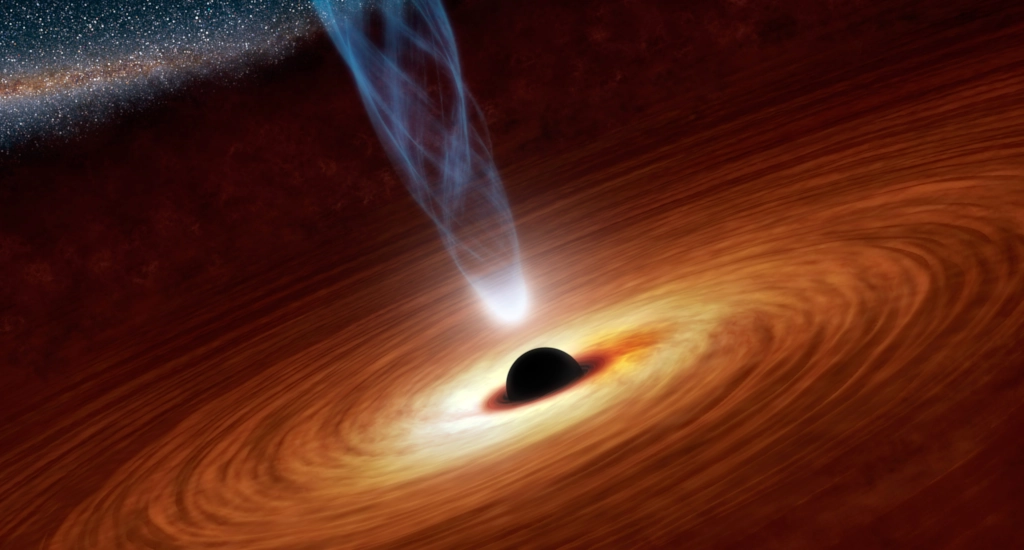
However, this process is influenced by outflows from active galactic nuclei (AGN), which are supermassive black holes accreting matter at the center of galaxies. These outflows can heat the gas, thereby reducing star formation and altering the galaxy’s evolution. Conversely, they can also compress gas clouds, increasing the rate of star creation. Additionally, radio jets emitted by some AGNs can inhibit star formation on a larger scale by affecting peripheral gases.
To study these effects, the BAH team will use carbon monoxide (CO) as a tracer for cold molecular gas, which is undetectable by its hydrogen emission due to low temperatures. CO emits radiation in a spectrum that ALMA can detect, allowing the researchers to estimate the gas mass and analyze the chemical and physical conditions of the molecular clouds.
ALMA’s capabilities are crucial for this research. Situated at an altitude of 5,000 meters in the Atacama Desert, ALMA consists of 66 antennas that combine signals through interferometry, enhancing observation sensitivity. It is recognized by the Guinness Book as the most expensive ground-based telescope, excelling in detecting detailed millimeter and submillimeter electromagnetic spectrum waves.
Not New
The BAH project is a continuation of previous research by the group, which began in 2019 when Riffel was a postdoctoral fellow at Johns Hopkins University. They previously used data from NASA’s Spitzer Telescope to study nearby galaxies rich in molecular hydrogen within warm gas clouds. In 2021, they were selected to analyze three galaxies with the James Webb Space Telescope (JWST), focusing on how supermassive black holes feed and how outflows impact gas clouds. In 2022, they utilized the Gemini Telescope to observe ionized gases.
The new study with ALMA will explore the coldest phase of gas in the interstellar medium, which has not been accessible to other telescopes. “We can now complete the picture by including the lowest temperature phase with ALMA,” Riffel explains.
The Brazilian scientists in the BAH project will conduct their research in the astrophysics laboratories of UFSM and UFRGS, supported by funding from the National Council for Scientific and Technological Development (CNPq), the Coordination for the Improvement of Higher Education Personnel (CAPES), and the Research Support Foundation of the State of Rio Grande do Sul (FAPERGS).
The international BAH team includes researchers from the Center for Astrobiology in Spain, the Institute of Fundamental Physics in Madrid, the Institute of Astrophysics of the Canary Islands, and Johns Hopkins University in the United States.
Although Brazil does not contribute financially to ALMA, researchers from Brazil and around the world can submit proposals for observation time. The telescope is funded through a partnership involving European Southern Observatory, the U.S. National Science Foundation, the National Research Council of Canada, the National Institutes of Natural Sciences of Japan, Academia Sinica of Taiwan, and the Republic of Chile.
Like my content? Support me with a tip!