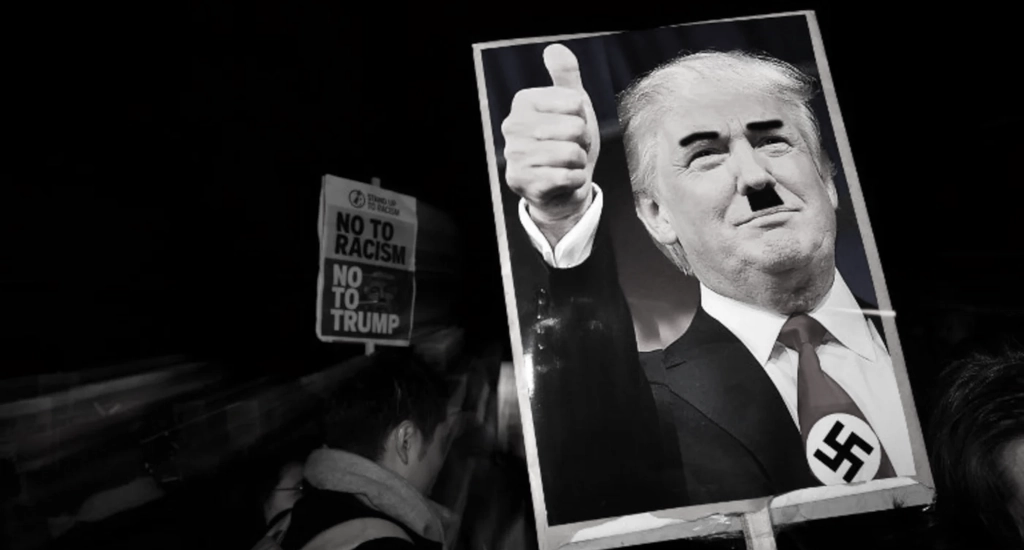
Donald Trump’s return to the presidency in 2025 has not brought the promised renewal of American greatness—it has instead exposed the fragility of democratic institutions and reignited deep-seated divisions within the nation.
The parallels to dangerous historical precedents are not mere rhetorical flourishes—they are warnings. If unchecked, Trump’s authoritarian playbook risks turning the United States into a nation where power is concentrated in the hands of a single leader, where truth is malleable, and where opposition is treated as treason. The time for alarm, reflection, and resistance is now.
Political Strategy and Consolidation of Power
Hitler (1933):
- Appointed Chancellor in January 1933 with broad coalition support, but quickly dismantled democratic checks and balances.
- Exploited the Reichstag Fire (February 1933) to pass the Reichstag Fire Decree, suspending civil liberties and enabling mass arrests of communists and socialists.
- Passed the Enabling Act in March 1933, granting Hitler dictatorial powers and effectively ending parliamentary democracy.
Trump (2025):
- Re-elected with a narrow margin, facing deep polarization.
- Issued numerous executive orders targeting immigration, labor rights, environmental regulations, and media freedom.
- Sought to expand presidential powers through legal challenges and executive actions.
- No equivalent of the Enabling Act has been passed, but there is a documented effort to erode institutional norms and expand unilateral executive authority.
Rhetoric and Propaganda
Hitler:
- Used mass rallies, radio broadcasts, and state-controlled media to spread nationalist, anti-Semitic, and anti-democratic messages.
- Cultivated a cult of personality as the “Führer,” presenting himself as the savior of the German people.
- Blamed Jews, communists, and the Treaty of Versailles for Germany’s problems, creating a narrative of national humiliation and the need for radical renewal.
Trump:
- Used social media (especially X/Twitter) and rallies to communicate directly with supporters, bypassing traditional media.
- Promoted the “Great Replacement” theory and other conspiracy-laden narratives targeting immigrants, minorities, and political opponents.
- Repeatedly labeled the press as the “enemy of the people” and framed himself as the only one capable of restoring American greatness.
- Used slogans like “Make America Great Again” (MAGA), which some analysts compare to Nazi-era nationalist slogans due to their mobilizing and exclusionary tone.
Repression and Targeting of Opponents
Hitler:
- Established the Gestapo (secret police) and began systematic imprisonment of political dissidents.
- Instituted the first concentration camps (e.g., Dachau) in 1933 for political prisoners.
- Banned opposition newspapers, censored books, and purged civil servants and academics deemed disloyal.
Trump:
- Uses ICE and the Military to imprison immigrants and protesters.
- Created camps “for immigrants” that violate multiple human rights.
- Increased surveillance of activists, journalists, and political opponents under national security pretexts.
- Proposed legislation to criminalize certain forms of protest and dissent.
- Targeted progressive educators, LGBTQ+ advocates, and reproductive rights activists with policy rollbacks and public vilification.
Economic and Social Policies
Hitler:
- Implemented public works programs and rearmament to reduce unemployment funded by debt, laying the groundwork for war.
- Promoted Aryan economic exclusivity, stripping Jews of businesses and professions.
- Rewrote school curricula to reflect Nazi ideology and promoted eugenics.
Trump:
- Cut taxes for corporations and the wealthy while rolling back labor protections.
- Enacted policies restricting access to education and healthcare for marginalized groups.
- Promoted a version of “America First” economics, often at the expense of international alliances and multilateral cooperation.
International Relations and Militarism
Hitler:
- Withdrew from the League of Nations and began rearmament in violation of the Treaty of Versailles.
- Pursued aggressive expansionist policies in Europe, setting the stage for World War II.
Trump:
- Withdrew from international agreements (e.g., Paris Climate Accord, Iran nuclear deal).
- Increased military spending and promoted a more isolationist foreign policy.
- Is pursuing aggressive expansionist policies in Latin America and Europe.
Institutional Resistance and Democratic Safeguards
Hitler:
- Found little resistance from German institutions; the judiciary and military largely acquiesced.
- The Reichstag and other democratic bodies were quickly neutralized.
Trump:
- Found little resistance from American institutions; the judiciary and military largely acquiesced.
- Multiple investigations and legal challenges were launched against his administration. Resulting in nothing.
TL;DR
| Aspect | Hitler (1933) | Trump (2025) |
|---|---|---|
| Institutional Context | Weak democracy (Weimar Republic) | Weakening democratic institutions |
| Legal Path to Power | Enabling Act, legal dismantling | Executive orders, legal challenges |
| Violence Scale | Systematic, state-sponsored genocide | Not yet at that level, but rising tensions |
| Media Control | Total state control | Partial, but significant pressure/control |
Conclusion
The warning signs are real: the normalization of authoritarian language, the weakening of checks and balances, and the mobilization of a populist base against democratic norms are all reminiscent of historical precedents. As scholars and journalists have increasingly argued, it is not only permissible but necessary to draw comparisons to historical fascism when patterns of authoritarianism emerge.
As former White House Chief of Staff John Kelly stated:
“Trump certainly fits the general definition of a fascist… He wants the kind of generals who served Hitler.”
The lesson from history is clear: democracies do not collapse overnight. They erode through small, incremental steps. Vigilance, civic engagement, and institutional resilience remain the best defenses against authoritarianism.
Source: Aepetba, Wikipedia, Wikipedia
Like my content? Support me with a tip!