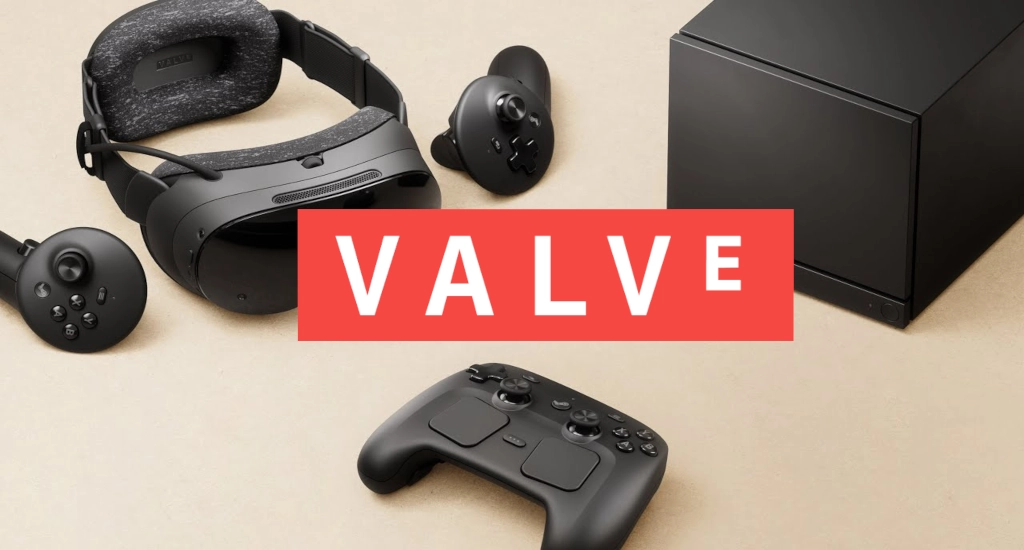
Following ages of rumors, Valve today released a short video announcing three new hardware products: a redesigned Steam Controller, a long-rumored VR headset called Steam Frame, and a new generation of Steam Machines.
Controller blends old and new.
Its body is large, similar to Valve’s earlier controller, but it borrows many modern features. The controller ships with two trackpads, haptics, a gyro, grip buttons, and capacitive (cap-sense) thumbsticks. It also includes a dedicated Steam button. The unit is wireless and charges via a magnetic charger.
New Standalone VR
The headset uses camera-based tracking — Valve shows no external base stations. It ships with a wireless adapter and supports magnetic thumbsticks for its controllers, following the Index design. Steam Frame is compatible with Steam Controllers. Crucially, the headset runs SteamOS, making it fully standalone-capable in the same way as other all-in-one headsets. The device also accepts SD cards to expand storage.
Steam Machines back from the dead
Thought to be effectively retired after their 2017 debut, Steam Machines are back as small, quiet desktop gaming systems. Valve claims the new models are roughly six times more powerful than the Steam Deck and can run 4K games at 60 fps using FidelityFX Super Resolution (FSR). Like the headset, the machines run SteamOS. They offer expandable storage via SD cards and support Steam Controllers.
What Valve showed today
All three products emphasize SteamOS integration and controller compatibility. Steam Controllers can pair across Valve’s ecosystem, and both the Steam Frame and Steam Machines support expandable storage via SD cards.
Valve did not provide pricing or firm release dates in the announcement video, other than shipping in early 2026. The company showcased hardware and key specs, but left availability and cost details for a later update.
Analysts and gamers will watch closely to see whether Valve’s renewed push into consoles and VR can translate into broad consumer adoption. For now, the video confirms Valve intends a deeper hardware footprint built around SteamOS and cross-device compatibility.
Like my content? Support me with a tip!