
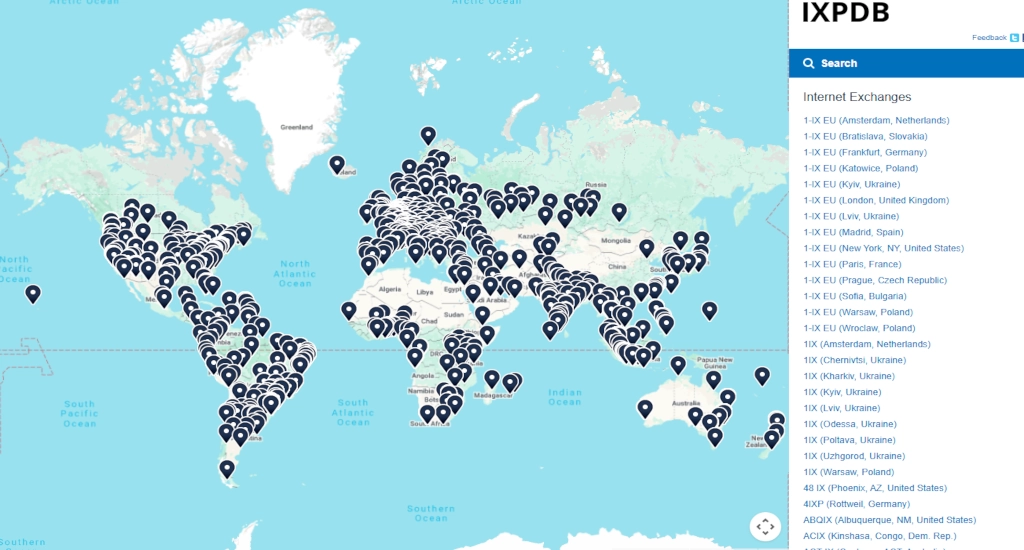
An Internet Exchange Point (IXP) is a physical network hub where autonomous networks meet to exchange traffic directly. Operators use BGP to peer over a shared switching fabric, reducing transit costs, latency, and dependence on upstream providers. ISPs, content providers, cloud platforms, and universities commonly connect to IXPs.
How IXPs work (practical view)
- Networks bring a router to an IXP and connect it to a shared switching fabric.
- They use BGP (Border Gateway Protocol) to announce the IP blocks they can reach.
- When two networks agree to exchange traffic, traffic flows over the IXP switch instead of through a paid transit provider.
- Many IXPs provide a route server — a service that simplifies peering by allowing many networks to peer through one set of BGP sessions rather than configuring hundreds of individual sessions.
Why IXPs exist — the core benefits
- Lower cost. Exchanging traffic locally avoids paying upstream transit for that traffic.
- Lower latency. Direct paths shorten the route between users and services (faster web pages, smoother video, better gaming).
- Higher resilience. Multiple local paths and peering reduce dependence on a single transit provider.
- Local ecosystem growth. IXPs attract CDNs, cloud providers and content platforms, which amplifies local capacity and competition.
Types and common architecture notes
- Non-profit / community IXPs (many run by academic or industry groups).
- Commercial / for-profit IXPs (run like a business and may operate multiple data centers).
- Carrier-neutral data centers host IXPs to let any network connect.
- Distributed IXPs run in many metro locations under one administrative umbrella (some modern IXPs operate as a global fabric).
Typical components: high-performance switches, redundant route servers, monitoring, peering LANs and optionally DDoS-mitigation services.
Biggest IXPs — ranked by reported peak traffic
Below is a ranked list of the biggest Internet Exchange Points by maximum throughput as reported by them and listed on wikipedia(on October 2025).
- IX.br (Brazil Internet Exchange — aggregate) — 42,190 Gbit/s ≈ 42.19 Tbps.
- DE-CIX (Deutscher Commercial Internet Exchange — global / Frankfurt flagship) — 22,360 Gbit/s ≈ 22.36 Tbps.
- Equinix Exchange (distributed, multiple cities / carrier-neutral sites) — 19,600 Gbit/s ≈ 19.600 Tbps.
- PIT Chile — 15,100 Gbit/s ≈ 15.10 Tbps.
- AMS-IX (Amsterdam Internet Exchange) — 12,075 Gbit/s ≈ 12.075 Tbps.
- DATA-IX — 9,569 Gbit/s ≈ 9.569 Tbps.
- JPNAP (Japan Network Access Point) — 8,160 Gbit/s ≈ 8.160 Tbps.
- NL-ix — 7,980 Gbit/s ≈ 7.980 Tbps.
- LINX (London Internet Exchange) — 5,820 Gbit/s ≈ 5.820 Tbps.
- NetIX — 4,670 Gbit/s ≈ 4.670 Tbps.
Like my content? Support me with a tip!