Three days before the opening whistle, the 2026 FIFA World Cup finds its host nation consumed by controversies far removed from the pitch. Wartime geopolitics, immigration enforcement, and street violence have converged in ways that no football governing body could have predicted — or planned for.
Iraq’s Hero Held for Seven Hours
When Aymen Hussein touched down at Chicago’s O’Hare International Airport in the early hours of Saturday morning, Iraqi fans had gathered in the arrivals hall, flags in hand, ready to welcome him. What followed instead was a seven-hour ordeal at the hands of U.S. border authorities that shook the international football community.
Hussein was detained and questioned for nearly seven hours after arriving in the United States. His phone was inspected throughout. He was eventually allowed to enter the country — but the team’s official photographer, Talal Salah, was held for more than ten hours, underwent similar phone checks, and was ultimately denied entry entirely.
Hussein is the man whose goal sent Iraq to the World Cup for the first time in forty years. Contrary to viral rumors, he was never officially arrested or jailed — but the border experience left a deep mark on the Iraqi football community, with local media describing him as having been “treated like a criminal.” ICE and the Department of Homeland Security did not respond to requests for comment.
Iran: Fly In, Play, Leave — No Overnight Stays
In perhaps the most extraordinary arrangement in World Cup history, Iran’s national team has been told they cannot sleep in the United States. The directive means the squad will only be permitted to cross the border on the morning of their games and must depart immediately after the final whistle. Iran’s ambassador to Mexico confirmed the situation directly: “We can enter in the morning and we must leave the same day.”
Mexican President Claudia Sheinbaum confirmed that FIFA approached her government after U.S. authorities said they did not want Iran staying in the country throughout the tournament — even though Iran is scheduled to play three Group G matches on U.S. soil, in Los Angeles and Seattle. Mexico agreed to host the squad at a base camp, allowing them to commute across the border for each game.
Tensions escalated further after visa applications for more than twelve key members of Iran’s support staff were denied, including the secretary general of the Football Federation, the national team’s delegation chief, and media officers. Players’ visas were eventually issued through the U.S. Embassy in Turkey — an unusual diplomatic workaround.
President Trump had initially said it would not be “appropriate” for Iran to participate at all, citing concerns for their “life and safety.” Iran’s football federation responded by calling for the United States to be excluded from the tournament. FIFA said nothing.
Shootings and Stabbings in Host Cities
The violence hit close — literally. Two separate shooting incidents near England’s World Cup base camp in Kansas City left two people dead and nine others injured over the weekend, raising fresh concerns about gun violence just days before the tournament begins.
Then on Sunday evening in New York, six people were injured in a stabbing attack inside Penn Station on the NJ Transit concourse. Amtrak Police took the suspect into custody. Penn Station is expected to handle tens of thousands of World Cup travelers heading to MetLife Stadium in New Jersey, which will host eight matches including the final.
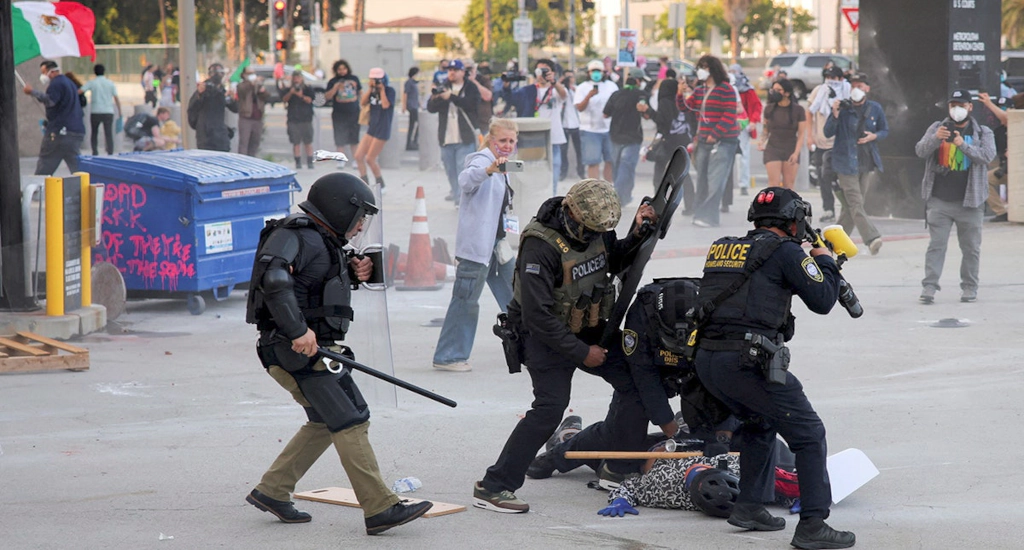
New York had already seen trouble earlier in the weekend, when 26 people were arrested outside Madison Square Garden during rowdy scenes after an NBA Finals watch party and a police officer was assaulted.
ICE at the World Cup
The official confirmation of active ICE deployment at the 2026 FIFA World Cup has sparked widespread fear and backlash among immigrant communities. Federal authorities maintain that personnel will focus strictly on tournament security rather than mass deportations, yet the policy has already triggered legal challenges and stadium worker strike threats.
More than 2,000 workers at SoFi Stadium in Los Angeles voted to authorize a potential labor stoppage unless they receive assurances that ICE will not conduct deportation operations inside or outside the venue.
Fears were further stoked by a Human Rights Watch report documenting the arrest and deportation of an asylum seeker who had simply attended the Club World Cup final in New Jersey with his children. More than 120 U.S. civil rights organizations, including the ACLU, issued a travel advisory warning of the “risk of serious rights violations” to fans, players, journalists, and other visitors.
From January 20, 2025 to March 10, 2026, ICE arrested at least 167,000 people in and around the eleven U.S. host cities. Human Rights Watch urged FIFA to push for a public “ICE Truce” guaranteeing non-enforcement at venues. Instead, in December 2025, FIFA awarded Trump its first-ever FIFA Peace Prize.
Homeland Security Secretary Markwayne Mullin has not ruled out enforcement actions involving people suspected of criminal activity, leaving immigrant communities, international visitors, and stadium workers in a state of sustained uncertainty as the tournament begins.
Source: Reuters, CNN, Al Jazeera, Al Jazeera, Human Rights Watch