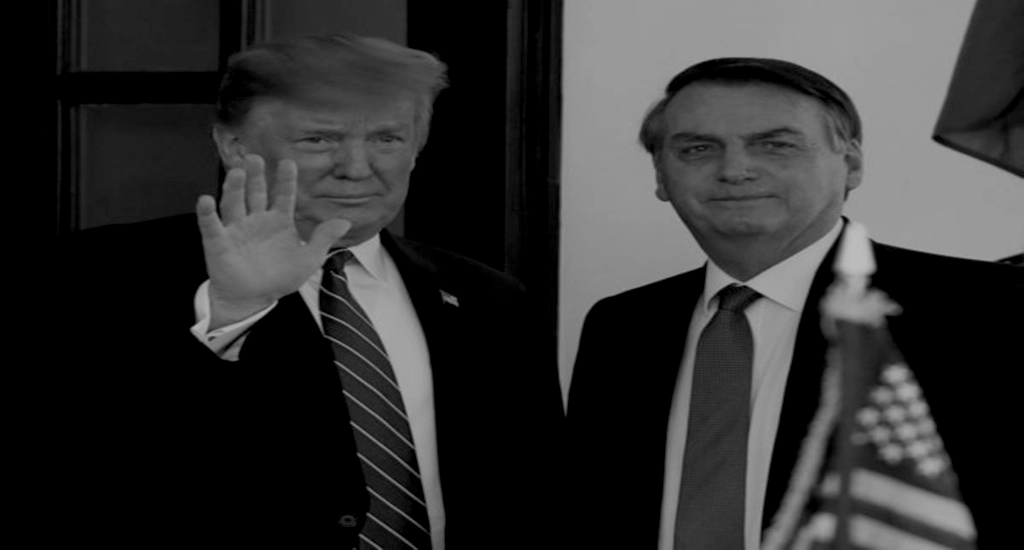
The political movements known as “Make America Great Again” (MAGA) in the United States and Bolsonarismo in Brazil emerged in the 2010s as right-wing populist phenomena. Though rooted in different national contexts, they share striking similarities in rhetoric, tactics, and appeal. However, Bolsonarismo, while inspired by MAGA, has displayed more overtly authoritarian tendencies and a more profound rejection of democratic norms.
Shared Foundations
Both movements are anchored in a nostalgic appeal to a mythic past, a rejection of political elites, and a moral panic about social change. They mobilize a base that feels left behind by globalization, threatened by cultural shifts, and disillusioned with traditional politics. Their leaders—Donald Trump(Republican) and Jair Bolsonaro(PL)—present themselves as anti-establishment figures who “speak the truth,” using social media to bypass traditional media and communicate directly with supporters.
Both MAGA and Bolsonarismo employ a politics of grievance, framing their supporters as victims of a corrupt system. They are also marked by a strong emphasis on “law and order”, “nationalism”, and a skepticism toward scientific consensus, most notably during the COVID-19 pandemic.
Rhetorical and Tactical Overlaps
- Populist Binary: “Us vs. Them” is central to both movements. The “enemy” can be immigrants, the press, “globalists,” or “cultural Marxists.”
- Anti-Expertise: Both movements have attacked experts, scientists, and public health officials, promoting conspiracy theories and alternative facts.
- Media Bashing: The press is portrayed as an adversary, and both leaders have sought to delegitimize media institutions.
- Cult of Personality: Trump and Bolsonaro are seen by their followers as incorruptible, strongmen who will “restore” national greatness.
Bolsonarismo’s Authoritarian Edge
While MAGA has flirts with authoritarianism, Bolsonarismo has been more explicit and consistent in its rejection of democratic checks and balances. Bolsonaro has openly praised Brazil’s 1964–1985 military dictatorship, called a notorious torturer a “national hero,” and repeatedly questioned the integrity of Brazil’s electoral system, even before taking office.
Bolsonaro’s rhetoric has often crossed the line into incitement. He has encouraged supporters to arm themselves, attacked democratic institutions (such as the Supreme Federal Court), and attempted to politicize the armed forces. His government systematically undermined environmental protections, Indigenous rights, and public health, most egregiously during the pandemic, when his administration promoted unproven treatments and downplayed the virus’s severity.
In contrast, while Trump’s rhetoric was inflammatory and often antidemocratic, the institutional resilience of the U.S. system—combined with a more robust tradition of press freedom and civil society—limited the damage. Bolsonaro, by contrast, presided over a more rapid erosion of democratic norms in a country with a shorter and more fragile democratic history.
Social and Cultural Dimensions
Both movements are deeply intertwined with “conservative Christian values”, but Bolsonarismo has a more pronounced religious dimension. Evangelical leaders in Brazil have been central to Bolsonaro’s political base, and his government actively promoted “Christian values” in policy and rhetoric, often at the expense of minority rights.
MAGA, while also supported by evangelical Christians, is more of a coalition of interests—economic nationalists, anti-immigrant groups, and traditional conservatives—whereas Bolsonarismo is more homogeneously aligned with a socially conservative, religiously inflected agenda.
Policy and Governance
In policy terms, both movements embraced economic liberalism, deregulation, and a hardline stance on immigration. However, Bolsonaro’s government went further in dismantling environmental agencies, weakening indigenous land protections, and encouraging illegal mining and deforestation in the Amazon. The human and ecological costs of Bolsonarismo’s policies have been catastrophic, with long-term consequences for Brazil and the planet.
MAGA’s policies, while damaging in areas like immigration and climate, did not reach the same level of institutional sabotage or environmental recklessness.
Propaganda and Misinformation: The Engines of MAGA and Bolsonarismo
Propaganda and misinformation are not new to politics, but MAGA and Bolsonarismo elevated them to central strategies for governance and mobilization. Both movements mastered the use of digital platforms to bypass traditional media, create echo chambers, and spread narratives that often bear little relation to reality.
MAGA: Weaponizing Social Media and “Alternative Facts”
Donald Trump’s campaign and presidency were marked by a relentless stream of tweets, rallies, and media appearances that blurred the line between political messaging and outright falsehoods. The term “alternative facts,” coined by Trump adviser Kellyanne Conway, became emblematic of the movement’s approach to truth.
Key Tactics:
- Twitter as a Propaganda Tool: Trump’s @realDonaldTrump account was used to set the news agenda, attack opponents, and spread unverified or false claims.
- “Fake News” Narrative: By branding mainstream media as “the enemy of the people,” MAGA delegitimized fact-checking and critical journalism, encouraging supporters to distrust any information that contradicted the movement’s narrative.
- Conspiracy Theories: MAGA amplified baseless claims—such as “Obamagate,” “rigged elections,” and “birtherism”—to energize its base and paint political opponents as corrupt or illegitimate.
- Selective Data and Misleading Statistics: MAGA frequently cited cherry-picked data to support claims about crime, immigration, or the economy, often without context or verification.
While these tactics were effective at mobilizing supporters and dominating media cycles, they were partially checked by U.S. institutions, including the press, courts, and tech platforms (which eventually banned or limited Trump’s accounts after the Capitol riot).
Bolsonarismo: A More Systematic and Dangerous Approach
Bolsonarismo’s use of propaganda and misinformation was not only more aggressive but also more deeply embedded in the machinery of the state. Bolsonaro’s government and allied networks—particularly through WhatsApp, Telegram, and YouTube—created a parallel information ecosystem that actively undermined public health, science, and democracy.
Key Tactics:
- State-Sponsored Disinformation: Unlike MAGA, which relied more on informal networks, Bolsonaro’s government was directly implicated in spreading misinformation. The Ministry of Health, for example, promoted unproven “early treatment” for COVID-19, while official channels downplayed the pandemic’s severity .
- WhatsApp “Factories”: Bolsonarista networks used mass-distribution WhatsApp groups to spread false claims about vaccines, elections, and political opponents. These messages often included manipulated images, fake expert quotes, and doctored videos.
- Attack on Science and Institutions: Bolsonaro and his allies systematically discredited scientists, universities, and environmental agencies. The Brazilian Institute of Geography and Statistics (IBGE) and the National Institute for Space Research (INPE) were attacked when their data contradicted government narratives.
- Electoral Distrust Campaign: Bolsonaro repeatedly claimed—without evidence—that Brazil’s electronic voting system was “fraudulent,” laying the groundwork for post-election unrest and attempts to delegitimize the 2022 election results.
- Religious and Moral Panic Propaganda: Bolsonarista messaging often framed political issues in apocalyptic religious terms, portraying “gender ideology,” “cultural Marxism,” and “globalism” as existential threats to the family and the nation.
Comparative Impact
While both movements used misinformation to polarize and mobilize, Bolsonarismo’s propaganda was more dangerous for several reasons:
- Scale and Reach: Brazil’s reliance on WhatsApp for communication—combined with weak regulation—allowed false information to spread more rapidly and widely than in the U.S.
- State Involvement: Bolsonaro’s government not only tolerated but actively promoted disinformation, turning it into a tool of governance.
- Public Health Consequences: Bolsonarista misinformation during the pandemic contributed to vaccine hesitancy, mass gatherings, and a higher death toll. Brazil became one of the world’s COVID-19 hotspots, in part due to government-led disinformation [REFERENCIA_5].
- Democratic Erosion: By attacking electoral institutions and the judiciary, Bolsonarismo sowed distrust in the very foundations of Brazilian democracy, culminating in the January 8, 2023, attacks on government buildings in Brasília.
Conclusion: A Comparative Verdict
MAGA and Bolsonarismo are siblings in the global wave of right-wing populism, but Bolsonarismo is the more dangerous and antidemocratic of the two. While Trump’s movement tested the limits of American democracy, Bolsonaro actively sought to dismantle Brazilian democratic institutions and rollback protections for vulnerable populations and the environment.
In the end, neither should have ever been elected.
Read more about MAGA and Bolsonarism on wikipedia.
 Buy me a Ko-fi
Support this blog ❤️