The European Space Agency (ESA) has taken a significant step forward in the study and exploration of near-Earth asteroids, successfully updating the flight software of its Hera spacecraft while the probe hurtles through deep space some 140 million kilometers from Earth.
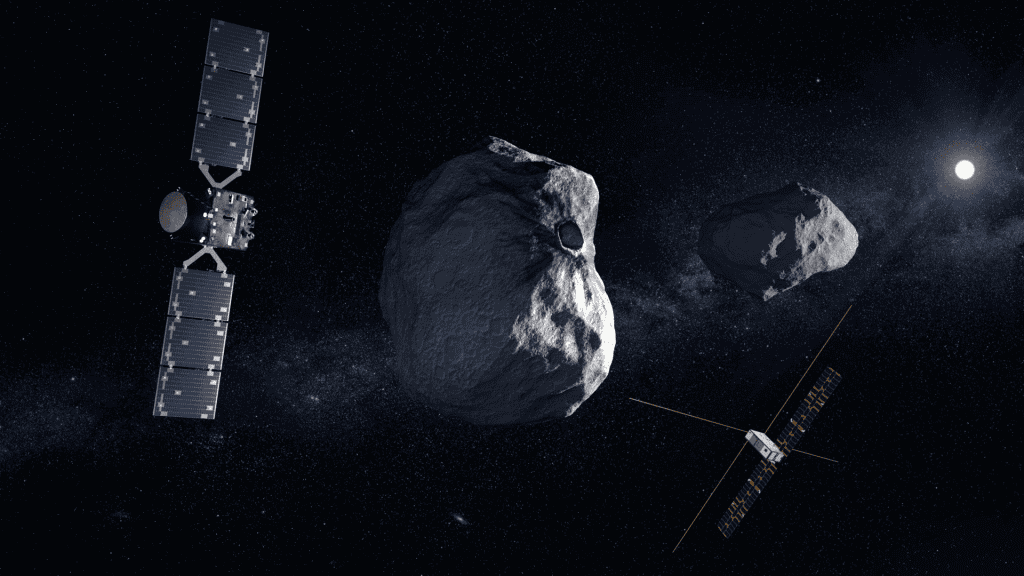
The operation, carried out by mission controllers at ESA’s European Space Operations Centre (ESOC) in Darmstadt, Germany, marks one of the most important milestones yet for the planetary defense mission. The newly installed software will enable Hera to activate its autonomous navigation systems, test its remaining scientific instruments, and establish communications with two CubeSats that will be deployed during the asteroid encounter phase.
A Software Upgrade at Interplanetary Speeds
Performing a software update on a spacecraft traveling at more than 12 kilometers per second presented a formidable technical challenge. With no possibility of physical access, the team relied on ESA’s 35-meter deep-space antennas to transmit the new code and execute the delicate procedure.
The process required a meticulously choreographed sequence of commands, followed by two full reboots of the spacecraft’s onboard computer. Hera’s computing architecture features parallel processors designed for redundancy, allowing engineers to evaluate each processing unit separately before resuming full operations.
“This update represents the definitive preparation of the spacecraft for its asteroid phase,” said Anna Schiavo, Hera’s operations engineer. “The new software will allow us to activate the remaining instruments and autonomous systems essential for exploring these celestial bodies up close.”
Rigorous Ground Validation Before Launch
Prior to launch, the flight software underwent an extensive validation campaign at ESOC that spanned approximately 18 months. The effort included 50 days of intensive ground testing, during which engineers simulated navigation scenarios around Dimorphos and Didymos and rehearsed communications between the main spacecraft and its accompanying CubeSats.
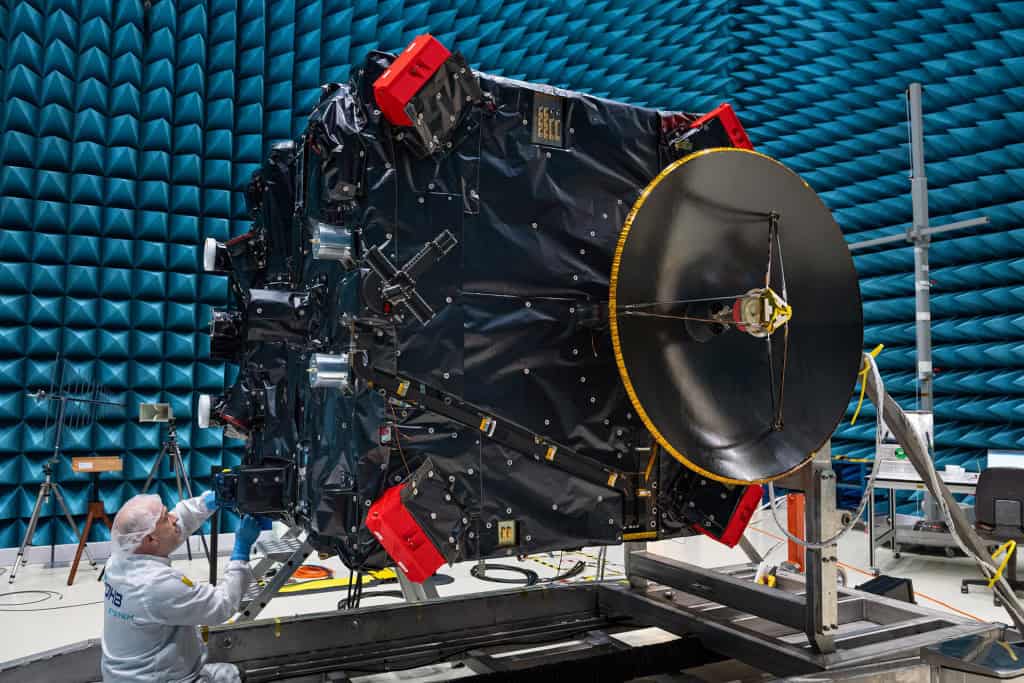
Sylvain Lodiot, ESA’s head of planetary defense and outer Solar System operations, explained that much of this preparation took place on a functional replica of the Hera spacecraft installed at OHB System AG in Bremen, Germany. “The replica allowed us to reproduce flight scenarios, model the asteroids, and test the communication links between the mothership and the small satellites under realistic conditions,” Lodiot said.
A Race Against the Launch Window
Despite the thorough ground testing, Hera launched in October 2024 without its final flight software. Caglayan Guerbuez, the spacecraft’s operations manager, noted that the mission had to meet a precise launch window to take advantage of a Mars gravity assist. “A delay would have pushed the arrival at the asteroid system back by years,” Guerbuez explained. “We prioritized launch timing and planned the software update for the cruise phase.”
Mission Purpose: Turning Impact Into Knowledge
Hera is ESA’s first dedicated planetary defense mission. Its target is the binary asteroid system consisting of the 160-meter-wide Didymos and its smaller moonlet, Dimorphos, which measures about 50 meters in diameter.
The scientific interest in this system stems from a historic event: in September 2022, NASA’s DART (Double Asteroid Redirection Test) spacecraft deliberately collided with Dimorphos, successfully altering its orbit around Didymos. While ground-based telescopes confirmed the orbital change, many details about the impact’s effects on the asteroid’s surface and internal structure remain unknown.
Hera will arrive at the system in 2026 to conduct a close-up investigation of the impact crater and the broader consequences of the collision. By characterizing the crater morphology, measuring the asteroid’s mass and composition, and analyzing the ejected material, the mission aims to transform the kinetic impactor technique from a one-time experiment into a validated, repeatable planetary defense strategy.
“The data Hera collects will be crucial for understanding how we might respond if a hazardous asteroid is ever found on a collision course with Earth,” mission planners say. With its software now updated and its systems primed for asteroid operations, the spacecraft is on track to deliver unprecedented insights into both asteroid science and planetary defense.
Source: Olhar Digital
 Buy me a Ko-fi
Support this blog ❤️