A team of three students from the Institute of Mathematical and Computer Sciences (ICMC) at the University of São Paulo (USP) in São Carlos has developed an artificial intelligence-powered fact-checking chatbot for WhatsApp. Named “Tá Certo Isso AI?” (“Is This Right AI?”), the tool uses multimodal AI to analyze and cross-reference various types of content—such as text, images, audio, and video—against trusted sources. The project was created in response to the growing threat of disinformation in Brazil, especially with the 2026 elections on the horizon.
The chatbot, developed by Cauê Paiva Lira, Luiz Felipe Diniz Costa, and Pedro Henrique Ferreira Silva, all Computer Science students, functions as a public platform for content verification. Their innovation recently earned them first place in the AI4Good Program, part of the Brazil Conference—an event organized by Brazilian students in the United States. As winners, the team will present their tool at the 12th edition of the Brazil Conference, held from March 27 to 29 at Harvard University and the Massachusetts Institute of Technology (MIT) in Cambridge, USA.
From Hackathon to International Recognition
The project began during a 2025 hackathon organized by the USP’s Rede de Avanço em Inteligência Artificial (Raia) extension group, which challenged participants to propose solutions to mitigate the impact of fake news. “We had only 10 hours to come up with the idea, and we won,” recalls Lira. When the AI4Good call opened, the team quickly registered and was among only eight groups selected from 170 applicants for mentorship and acceleration.
During the six-week acceleration period, the students received guidance on technical and strategic aspects, including system architecture and user experience. “The hackathon version was about proving the concept, not robustness. The AI4Good program helped us mature the system,” explains Silva. One of the most significant improvements was the implementation of a curated list of reliable sources—such as official websites, established news outlets, and specialized fact-checking platforms—ensuring that the bot only verifies information against vetted references. “The bot doesn’t accept just any source. It checks only against bases that have already passed our reliability filter,” says Costa.
How the Chatbot Works
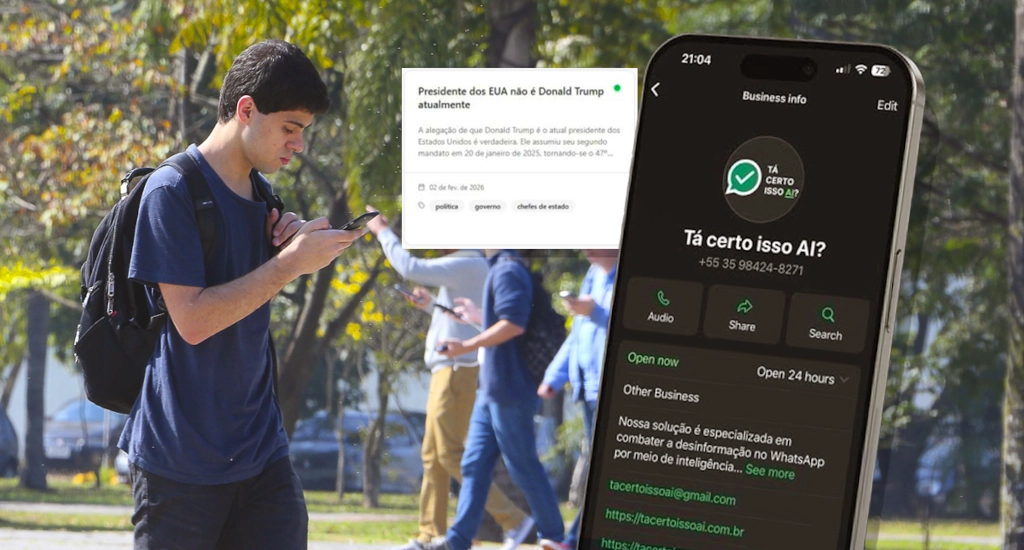
“Tá Certo Isso AI?” operates entirely within WhatsApp, eliminating the need for additional apps or external websites. Users can add the bot’s number to their contacts or access it via a link on the project’s website. Once added, they can forward any suspicious content—text, links, images, videos, audio, or even stickers—and the chatbot will quickly return an analysis, indicating whether the information is verifiable, which claims are true or false, and which sources were used.
The bot can also be added to WhatsApp groups. When a questionable message appears, any participant can tag the bot (@) in a reply, and the verification result is displayed for everyone in the group. “We focused heavily on user experience, so even people with little technological familiarity can use it,” says Silva.
Analytics and Future Partnerships
Beyond direct user interaction, the chatbot doubles as an analytics platform. All content submitted to the bot is aggregated into a public dashboard on the project’s website, allowing users to track trends and recurring disinformation topics. “WhatsApp is a black box. We don’t know how often misinformation is forwarded. Our analytics platform helps us understand the real-time scenario,” notes Lira.
The team also aims to partner with journalists, researchers, and organizations fighting disinformation. “We want to collaborate with these groups, allowing them to review the analyses produced by the system. With their feedback, we can fine-tune our AI models and make fact-checking even more accurate,” adds Lira.
The project’s social impact, technical maturity, and scalability were key factors in its recognition by the AI4Good program. The team is now preparing to present their work on the international stage, bringing Brazilian innovation to the forefront of the global fight against fake news.
Source: USP, TaCertoIssoAI
 Buy me a Ko-fi
Support this blog ❤️