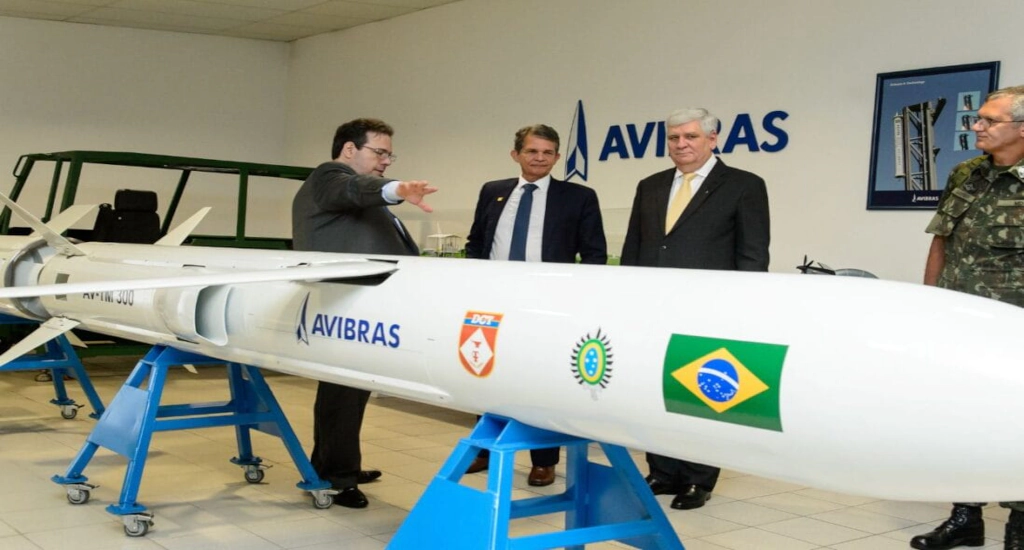
Deep in the Atlantic rainforest, hidden along the Tamoios Highway, Brazil’s largest defense contractor is coming back to life. After four years of dormancy under judicial recovery, Avibras Aeroco has restarted production across its 2.7-million-square-meter complex — and its CEO, Sami Hassuani, is issuing a stark warning: Brazil must urgently connect innovation funding with industrial financing and defense procurement, or risk losing its sovereignty on the modern battlefield.
Hassuani’s alert follows similar warnings from Defense Minister José Múcio Monteiro Filho, who recently stated that Brazil is “without defense.” Now, as Avibras ramps up production of new cruise missiles, rockets and drones inside its fortress-like facility — where no cellphones or computers are permitted and engineering servers are air-gapped from the internet — the CEO argues that industrial capacity is the missing vertex of what he calls the “triangle of sovereignty.”

A Complex Reawakened
The Avibras complex, nestled near the Jaguari reservoir in the Serra do Mar mountains, comprises 18 factory units operating under tight security. Most visitors are received outside the main facility; movement between units is controlled, and intellectual property is zealously guarded.
After receiving R$300 million from private investors — including JBS meatpacking magnates Joesley and Wesley Batista — the newly formed Avibras Aeroco inherited all assets and intellectual property from the original company. Ninety percent of the supplier chain has been restored, and the industrial sector has been reactivated after the prolonged shutdown.
Four steel drawing machines — among only five in all of Brazil — have resumed producing SS-80 and SS-40 rockets and missiles. The “Drawing Building” can process up to 5,000 rocket casings per month after each piece undergoes rigorous pressure-testing for quality control. Nearby, containers of Skyfire-70 70mm rockets — used by Embraer Super Tucanos and by Army and Air Force helicopters — await shipment. The “Snif Building” serves as the final assembly and integration point for munitions, where two units of Brazil’s new Tactical Cruise Missile (MTC) were recently being prepared.

New Weapons for a Changed World
The MTC, which has an initial range of 300 kilometers (extendable to 450 km), boasts a circular error probability of just 9 meters and can carry a 200-kilogram warhead. Powered by an 8-ton-thrust engine and weighing just over one metric ton, the missile is launched from the Astros artillery system and is slated for operation by both the Army and Air Force. Only three test flights remain before certification is complete, with the next launch scheduled for November. The company expects to sell up to 200 units annually, targeting export markets in the Gulf and Southeast Asia.
“We can deliver for export in two years — the Americans are only delivering what’s ordered now in 2032,” Hassuani told O Estado de S. Paulo, which toured the facility.
Alongside the MTC, Avibras is developing a new S+100 ballistic missile for the Army — a cheaper, hypersonic weapon with a 120-kilometer range that flies directly to its target without waypoint navigation, similar to systems used in the Ukraine and Gulf conflicts. The company is also expanding into drones, with a prototype UAV already built and an anti-drone system that creates a fragmentation curtain in the sky to neutralize enemy swarms.

Deliveries and Growth Trajectory
Avibras is currently producing two ammunition lots for the Army, delivering components for the Air Force’s space program, and preparing a batch of artillery munitions for a Gulf country customer. Modernization of the Astros launcher vehicle fleet is also underway.
With 500 employees already on board just two months after reopening, the company expects to begin assembling new rockets and cutting armor plates for Army vehicles in July, when the industrial complex is scheduled to be officially inaugurated with the attendance of commanders from all three armed forces. The Navy has also adopted the Astros system to fire Mansup anti-ship missiles from Marine Corps coastal defense batteries; the Mansup is manufactured by SIATT, which is 50% owned by the UAE’s Edge Group.
Revenue is projected at R$500 million by 2028, with the company anticipating a shift to dollar-based operations in 2029. Export deliveries of complete systems — not just spare parts — could begin as early as mid-2027, a year ahead of initial planning, according to Hassuani.

The “Triangle of Sovereignty” and Brazil’s Funding Puzzle
Hassuani argues that recent conflicts have exposed a critical vulnerability: even well-equipped forces can be defeated if their stockpiles run out and their industrial base cannot replenish them quickly. The traditional model — negotiation capacity plus armed forces — is no longer sufficient.
“The world changed. The model that worked until 2022 doesn’t work anymore,” Hassuani said. “The current model is the capacity to negotiate plus armed forces equipped with stock and the capacity to replenish stock in real time, independently. You need these three vertices to close and protect sovereignty.”
He advocates for a European-style approach that interconnects three funding streams: innovation resources from FINEP and the National Fund for Scientific and Technological Development (FNDCT); industrial credit lines from the BNDES development bank; and the Defense Ministry’s procurement budget. “Europe only gives innovation money if you have the whole path mapped out: the industrial money and the budget money that buys,” he said.
Hassuani also calls for Brazilian defense companies — including Avibras, SIATT and Mac Jee — to form consortia similar to those in Europe, so they can collectively organize around government-led programs with clear delivery timelines. At the Eurosatory defense fair in Paris, the company held talks with potential partners including MBDA, Rheinmetall, KNDS, Turkey’s Aselsan and Baykar, Israel’s Elbit and AEL, though no deals were signed.

Interview with Sami Hassuani
Below are translated excerpts from Hassuani’s interview with O Estado de S. Paulo:
How did activities begin in this new phase of the company, and what is the current situation?
This is a process that we started in August of ’25 with the change of control of Avibras and, in the sequence, within the judicial recovery process, Avibras Aeroco was created, a new company that inherited all the assets of Avibras. And so our life began with all these assets, with all the intellectual property, with all this technological legacy, in August last year.
What do you already have operating in the company?
From August until now, we’re about eight months in. What did we do? All the classic diligences: legal diligence, accounting and financial diligence, and two fundamental diligences: technology and the industrial side. We found that the technology was intact—servers, intellectual property, drawings, everything was intact—and the industrial side, all the machinery, the entire park was intact. Last, I did a commercial diligence. We visited clients in Brazil—the Forces—and abroad, we visited all active clients, who are several, mainly in the Gulf and Southeast Asia. All clients are eagerly awaiting the arrival of the new Avibras. And since then, we finished the audits, started back-office activities, installed legal, installed commercial, all engineering was activated. In March, we already had all engineering connected, all purchasing and procurement, and partnership areas resumed. And at this moment, we’ve just reviewed the entire industrial park. So now, it’s a ready company, with all processes installed, with the industrial area running, and we begin the production ramp-up. Officially, we’ve already started production. Obviously, this has to have a cadence, a ramp-up.
When will the first deliveries be made?
We will make deliveries this year and the top priority will be delivering to Brazil. We deliver ammunition lots, spare parts lots, still this year to the Army. I won’t go into quantity details, but we’ll deliver two lots still this year of ammunition, we’ll deliver parts, and we’ll also deliver to the Brazilian Air Force the continuity of the space program. So we have these deliveries and, next year, accelerating, we’ll step up.
We’ll have much larger deliveries for the Brazilian Army. We have new contracts, including new developments — a new guided ballistic missile of 120 km, which the whole market is waiting for, including clients abroad. So there’s a very big movement abroad for Avibras to also continue the development of the 300 km missile, which is practically ready, in the final stages of certification, and to launch this new product.
The 300 km tactical cruise missile?
The missile is already ready. We’re finalizing certification, the market wants it. And the market wants a smaller missile, not a cruise one, but ballistic, which is a bit different in how it flies, because it’s supersonic. It’s much faster. But it doesn’t navigate by waypoints, it goes straight to the target, which is what was used a lot in the engagements in the Ukraine and Gulf wars. And we’re developing this product together with the Brazilian Army.
Will exports begin next year? What’s the export situation?
All active clients have already been contacted, we’ve already had technical teams that went to the clients, so we’re already serving clients. They’re buying spare parts, which is most important in the very short term, and we’re discussing several supply contracts. In our planning, export would be for 2028. But I’m very confident that we’ll start exporting, really, not just parts but products. Maybe by mid-2027 we’ll already be exporting. We’ll anticipate by one year because the market is very strong.
How does this fit into the broader movement affecting Brazil’s entire defense industrial base — ensuring minimum defense of sovereignty? What has changed in the world and how should Brazil organize its defense industry?
I’d say that in current times we must rethink sovereignty. It’s a word that’s been much battered, because some believed sovereignty was the capacity to negotiate. And of course it is. And Brazil has that very well. But another group believed that, when diplomacy fails, you use force. So they defended the need for strong, trained, and equipped Armed Forces. That group was also right.
But the recent wars — and I just came from an international seminar and a fair in France — have shown that in modern conflict it’s not enough to have negotiation capacity and equipped armed forces, because your stock runs out. So the tripod that shields sovereignty was missing. I call it the triangle that protects sovereignty. The last vertex is industrial capacity, which replenishes stock quickly and in large quantities. Whoever doesn’t have industrial capacity is losing the war, despite having negotiation capacity and the initial capacity to face the conflict. But after 4 days you’re unarmed. So industry has become a fundamental part of sovereignty, able to be scaled in quantity, deliver lots quickly.
That’s what changed. The world changed. The model that worked until 2022 doesn’t work anymore. The current model is the capacity to negotiate plus armed forces equipped with stock and the capacity to replenish stock in real time, independently. You need these three vertices to close and protect sovereignty. And the Brazilian model — what’s missing for us? Everyone complains that there’s no money. And there isn’t enough money. But I think we can start already with new thinking.
What is the new thinking the world has?
What’s the new thinking? I have to integrate the three instruments that are available. First instrument: innovation. We have the FNDCT, run by the Ministry of Science and Technology, and FINEP, which are extraordinary instruments, important, that generate a lot of resources for innovation. But they can’t be disconnected. What countries are doing from 2024, 2025 and 2026? They only put money into innovation if the industrial leg and the purchasing leg are absolutely interconnected — and not just interconnected by wish.
The innovation money — which can be grants, can be technological procurement — has to be linked to the credit lines at BNDES, which are credit lines for industrial expansion, for industrial construction, for creating new production lines — and has to meet with the federal budget. When these three are absolutely interconnected, in fact, you have a lot more money available and then industry can plan.
Is this a path for Brazil to have more money?
This is the path. I’d say it’s not just the path to have more money, because there is money. Do we need more? We do, but the money as it is is somewhat dispersed, because the previous model had a certain integration — everyone talked to each other — but it didn’t have an actor that forced it, that said I only pay for innovation if you tell me what day you’ll deliver the product. That demand didn’t exist, which the world now requires. Europe only gives innovation money if you have the whole path mapped out: the industrial money and the money from the budget that buys.
Is this the path Brazil needs?
Mandatory, because the previous model was good, but it doesn’t work anymore. In Brazil there was nothing wrong per se. Brazil was at the forefront of innovation, but we weren’t getting the product to market on time. So if you don’t integrate — in Europe they don’t give innovation money anymore if you don’t have the following answer: “How will you industrialize and when will you deliver the lot and at what cadence?” Because I’m going to war. I need to defend myself.
We can’t do innovation just to be at the forefront anymore. We need the capacity to industrialize and have a budget to buy. And then — I think the most important thing — we need to unify the industry. We have to call all the companies and work in a synergistic way, because if we manage to organize these three resources, we can give organized orders to the entire defense industrial base.
Source: Estadão