A confidential letter from U.S. Secretary of State Marco Rubio to Senator Flávio Bolsonaro (PL-RJ), obtained by Brazilian media and reviewed by this publication, has ignited a firestorm in Brasília, with senior diplomats and government officials describing the correspondence as evidence of unprecedented American interference in Brazil’s internal affairs — and raising alarms about Washington’s intentions toward the country’s democratic future.
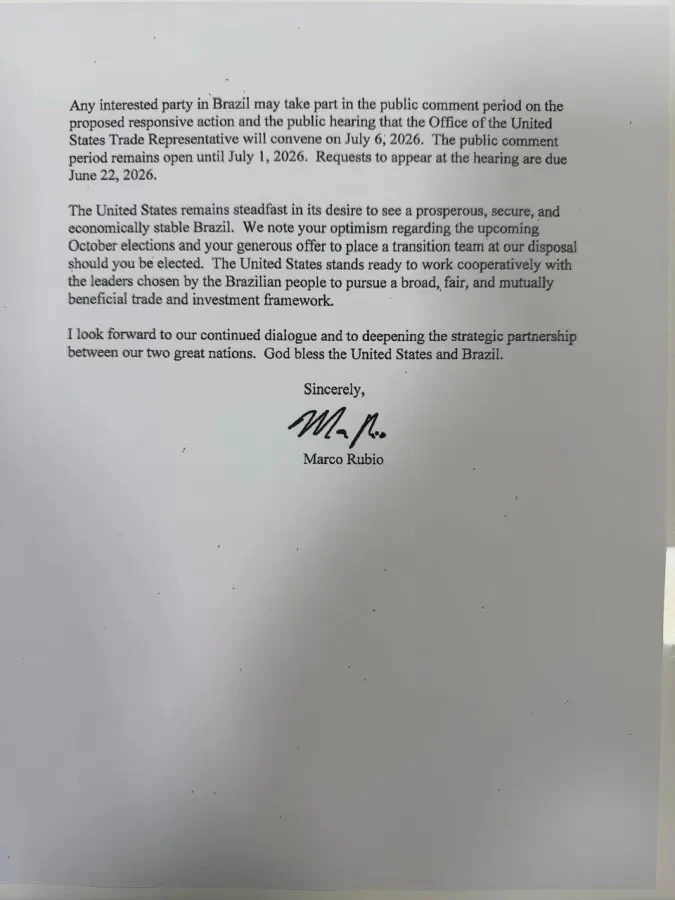
The Rubio letter and the transition team offer
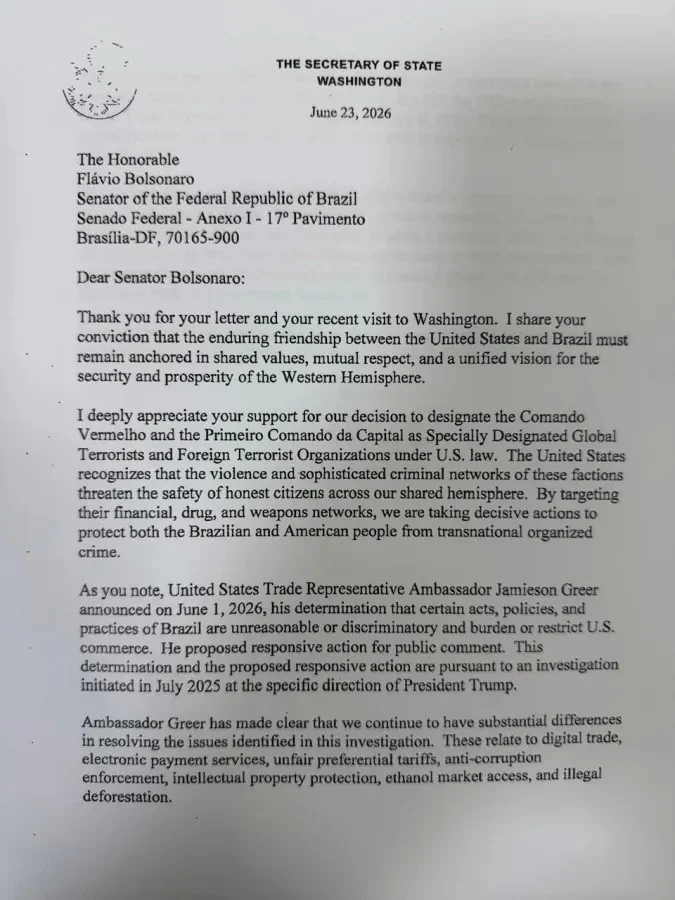
Dated Tuesday, June 23, Rubio’s letter acknowledges what Brazilian officials describe as an “unprecedented” gesture: Flávio Bolsonaro, a leading presidential pre-candidate, reportedly offered to place a full government transition team at the disposal of Donald Trump’s administration should Trump win the U.S. election in November. Rubio writes that Washington has taken note of Flávio’s “generous offer of placing a transition team at our disposal should you be elected,” and that the United States “remains firm in its desire to see a prosperous, secure and economically stable Brazil.”
But the apparent warmth masks a hard edge. Rubio also makes clear that Washington will move forward with imposing new tariffs on Brazilian exports — a decision announced roughly one week after Flávio met privately with Trump at the White House. “We continue to have substantial differences in resolving the issues identified” in a U.S. trade investigation, Rubio states, listing digital commerce, electronic payment systems like Pix, preferential tariffs, anti-corruption enforcement, intellectual property protection, ethanol market access and illegal deforestation as ongoing points of contention.
A public hearing on the proposed tariffs is scheduled for July 6, with Rubio inviting “any interested party in Brazil” to participate.
“Telegraphed” diplomacy and the Bolsonaro family’s role
According to sources in the Brazilian government speaking to ICL Notícias, the reference to a transition team is the clearest indication yet of Flávio Bolsonaro’s alignment with U.S. interests — a degree of submission that one seasoned diplomat, speaking on condition of anonymity, said they had “never seen before, not in this dimension.” Multiple observers in Brasília described the letter as “telegraphed”: a coordinated gesture designed to elevate Flávio Bolsonaro’s stature as a credible interlocutor for Washington, effectively positioning him as a potential alternative to Brazil’s current leadership.
Behind the scenes, the push for economic pressure on Brazil reportedly came from Flávio’s brother, former congressman Eduardo Bolsonaro (PL-SP). According to reporting by ICL Notícias, Eduardo advocated for the tariff package, visa revocations targeting Supreme Court ministers and federal government officials, and the application of Magnitsky Act sanctions — all in an apparent bid to deter ongoing prosecutions of their father, former President Jair Bolsonaro, in the coup-plot case.
Flávio Bolsonaro’s own letter to Rubio had pleaded against the 25% tariff proposal that emerged from a U.S. trade investigation. Rubio’s response, however, made no concessions, signaling that Washington’s leverage over Brazil’s economy will remain a central tool regardless of Brasília’s preferences.
Terrorist designations and security overreach
The Rubio letter also thanks Brazil for supporting the U.S. decision to classify the Primeiro Comando da Capital (PCC) and Comando Vermelho (CV) as Foreign Terrorist Organizations (FTOs). While the Bolsonaro camp hails the move, Brazilian security experts warn that such designations could provide a legal pretext for unilateral U.S. actions in Brazil under the banner of counterterrorism — a prospect that raises sovereignty concerns and could embolden hardline security policies domestically.
Trump’s eyes on Brazil
The diplomatic maneuvering coincides with an unmistakable signal from the top. On Friday, President Donald Trump shared a NewsMax article on his Truth Social platform declaring that Brazil’s upcoming presidential election represents “his next challenge.” The article, titled “Trump’s Next Challenge: Brazil,” frames the October vote as potentially the hemisphere’s most consequential, arguing that a rightward shift in Brasília would “dramatically” redraw Latin America’s political map.
Trump has recently hosted both of Brazil’s leading presidential contenders at the White House. He met President Luiz Inácio Lula da Silva (PT) last month, with both sides calling the encounter “very productive” on social media. Flávio Bolsonaro was received in May, though the White House only posted a photo of the two in early June — hours after the new tariff proposal surfaced. Flávio has publicly confirmed that he asked Trump to designate the PCC and CV as terrorist organizations, a request that was subsequently fulfilled.
A new chapter of hemispheric power
For Brazilian officials, the convergence of these events — the Rubio letter, the tariff threat, the terrorist designations, and Trump’s public focus on Brazil’s electoral calendar — points to a coordinated strategy that goes beyond normal diplomacy. The offer of a transition team, in particular, is being read in Brasília as an attempt to pre-emptively legitimize a political project aligned with Washington’s priorities, potentially bypassing the will of Brazilian voters.
As one senior diplomat put it to ICL Notícias: “We have never seen a degree of submission of this magnitude.” Whether that submission will translate into actual power at the ballot box remains to be seen. But the signals coming from Washington and the Bolsonaro camp suggest that the battle for Brazil’s future is being fought not just in Brasília, but in the corridors of American power — with democracy itself hanging in the balance.