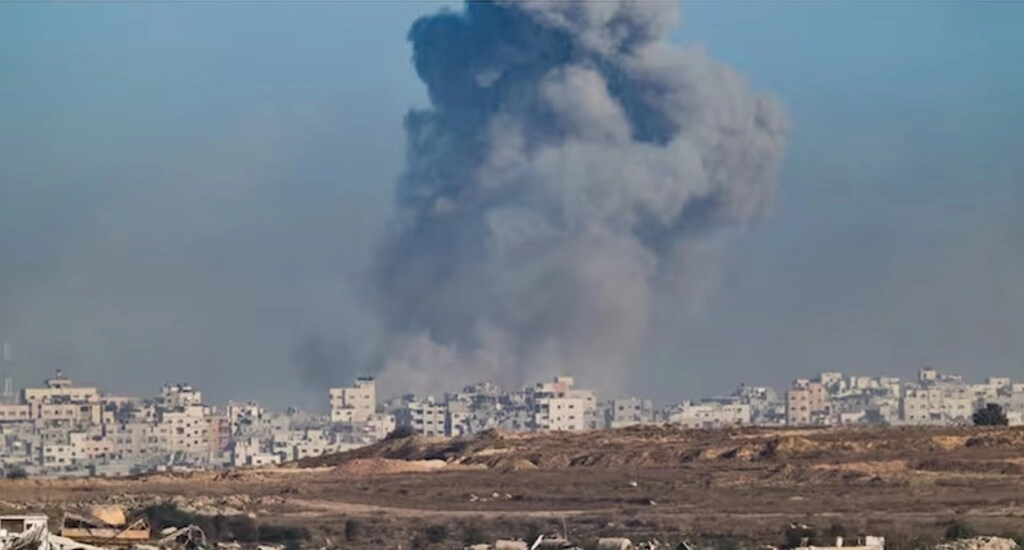
Let’s be clear about what happened. On February 28, 2026, the United States and Israel launched nearly 900 airstrikes in 12 hours targeting Iranian missile systems , air defenses, HIGHSCHOOLS and CIVILIAN infrastructure. This wasn’t a defensive reaction. It followed a pattern of escalating provocations — including Israel’s major strikes against Iranian nuclear and military facilities on June 13, 2025, which killed top Iranian commanders. The UK Parliament itself acknowledges that the US and Israel explicitly aimed to induce regime change in Tehran.
This was a war of choice, conceived in Washington and Tel Aviv, executed with the full weight of two of the world’s most powerful militaries against a nation that had not invaded another country in modern history. The consequences for the global economy were immediate, predictable, and catastrophic — yet Washington acted with breathtaking disregard for the rest of the planet.
The Oil Shock: A Global Punishment, An American Gift
Within 72 hours of the strikes, the Strait of Hormuz was effectively closed as Iran threatened and carried out attacks on shipping lanes. On March 4, 2026, oil and LNG exports were stranded, sending Brent crude soaring past $120 per barrel. The IMF warned that energy prices, supply chains, and financial markets were all transmitting the shock worldwide.
But here’s the bitter irony: American oil companies are laughing all the way to the bank. As global prices spiked, US shale producers posted record quarterly profits. Refiners in Texas and Louisiana expanded margins while ordinary people in Brazil, India, Nigeria, and Germany paid double for gasoline and heating oil. The US government, meanwhile, dipped into the Strategic Petroleum Reserve to keep domestic prices artificially low — exporting the pain while insulating its own citizens.
This is the ultimate moral abdication. The US started a war that choked off a critical artery of global energy supply, and then it refused to pay the bill, shifting the burden onto the very countries least responsible for Washington’s strategic blunders.
The Case for the Oil Toll
What would an “oil toll” actually mean? It would require the United States — and Israel, as co-belligerent — to reimburse every nation, corporation, and individual outside its own borders for the excess cost of oil caused by the war-induced price spike above pre-conflict levels. Not a voluntary “aid package.” Not vague promises of reconstruction. A direct, audited transfer of wealth proportional to the damage inflicted.
The rationale is simple:
- Causality: The US and Israel initiated the conflict. The closure of Hormuz and the destruction of Iranian infrastructure were direct consequences of their military campaign. By any legal or ethical standard, the party that causes harm bears the cost.
- Scale of Damage: The IMF estimates that a sustained energy shock of this magnitude could shave 1–2 percentage points off global GDP growth in 2026. For developing economies, that means food inflation, currency collapses, and social unrest — while US defense contractors and energy firms post record profits.
- Historical Precedent: After Iraq’s 1990 invasion of Kuwait, the UN Security Council imposed reparations for oil-related losses. The logic was identical: the aggressor pays. Why should the US be exempt?
- The Hypocrisy Tax: Washington lectures the world about “rules-based order,” democracy, and human rights — yet when it violates those very principles, it expects everyone else to quietly absorb the economic fallout. The world should stop subsidizing American hypocrisy.
The Stupidity of American Grand Strategy
What’s most infuriating isn’t just the moral failure — it’s the sheer strategic stupidity. The architects of this war — whether in the Pentagon, the White House, or Mossad — seem incapable of basic cause-and-effect reasoning:
- They bombed Iranian infrastructure, guaranteeing that oil would become scarcer and more expensive — then acted shocked when global inflation surged.
- They claimed to be “containing Iran” while driving the entire planet into China’s arms as those countries sought alternative energy sources and security guarantees.
- They demanded that OPEC increase production even as their own war made Iranian and regional oil impossible to ship — a contradiction so obvious it borders on self-parody.
- They spent billions on munitions and aircraft while ignoring the trillions in global economic damage their actions unleashed.
This is the pattern that has defined US foreign policy for decades: intervene militarily for short-term geopolitical gain, then expect the rest of the world to clean up the economic wreckage. The 2026 Iran war isn’t an aberration — it’s the logical endpoint of a doctrine that treats the planet as America’s personal billiard table.
Accountability Is the Only Path Forward
The world cannot continue operating under a system where the United States creates a crisis, profits from it, and then lectures others about “responsibility.” The oil toll isn’t just a moral imperative — it’s a practical mechanism to deter future wars of choice. If Washington knew it would have to write checks to every nation suffering from its military adventures, perhaps its leaders would finally think twice before pressing the button.
Until then, the rest of us are effectively paying America’s war premium — a silent, involuntary tribute to a superpower that long ago forgot the meaning of restraint, humility, and accountability.
The US started this war. The US must pay the oil toll. Anything less is complicity in economic violence masquerading as foreign policy.
 Buy me a Ko-fi
Support this blog ❤️