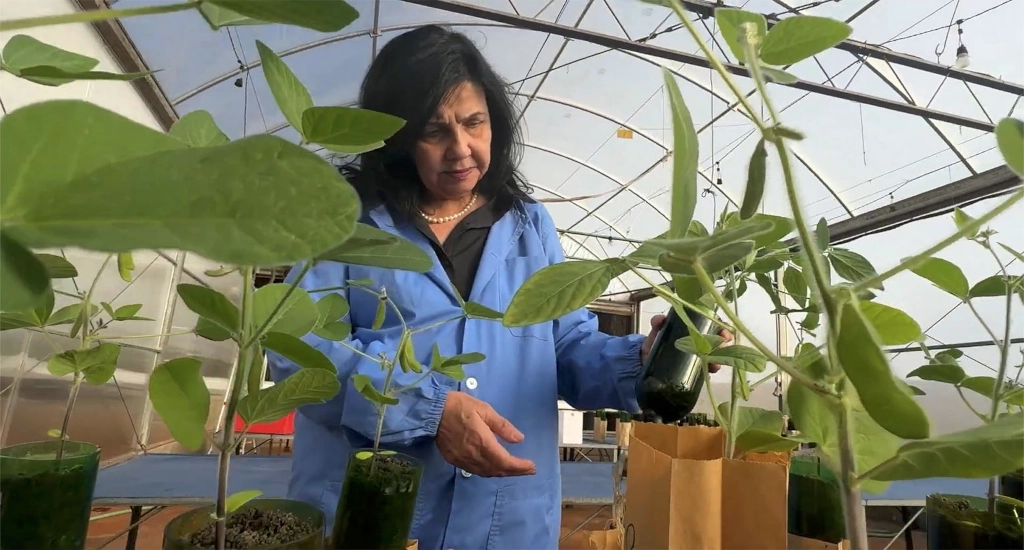
As geopolitical conflicts disrupt global fertilizer supplies and raise fears of a worldwide food shortage, the solution to feeding a growing population may not lie in a factory, but in the soil. At the Embrapa Soja research campus in southern Brazil, a breakthrough decades in the making is actively transforming global agriculture, saving billions of dollars, and slashing greenhouse gas emissions.
The pioneer behind this shift is Dr. Mariangela Hungria, a microbiologist who recently won the 2025 World Food Prize—often dubbed the Nobel Prize of Agriculture—and was named one of TIME Magazine’s 100 Most Influential People in April 2026. Her premise is elegant in its simplicity: harness naturally occurring bacteria to pull nitrogen directly from the atmosphere and feed it to crops, bypassing the need for environmentally toxic and expensive chemical fertilizers.
Harnessing Nature’s Formula
For decades, modern agriculture has been heavily dependent on synthetic, petroleum-based nitrogen fertilizers. While effective at boosting yields, these fertilizers are costly, resource-intensive to produce, and highly vulnerable to supply chain disruptions—as seen during the ongoing geopolitical conflicts in regions like Ukraine.
Hungria’s work centers on rhizobia, a symbiotic bacteria that forms nodules on the roots of legume crops like soybeans. While the scientific community has long known about biological nitrogen fixation, Hungria spent four decades isolating the most elite, efficient strains of these microorganisms and developing commercial inoculations that can be mass-applied to crops.
“I really did not discover anything. The solutions are all there in nature. We have to go and find them, and then improve the use of these microorganisms for the crops that we have today,”
– Hungria has noted regarding her life’s work.
The Economic and Environmental Dividend
Brazil is currently the world’s leading soybean exporter, feeding immense global demand, particularly from China. The mass commercialization of Hungria’s biological inputs arrived precisely when the agricultural sector needed it most.
The transition has yielded staggering results for Brazil’s agricultural economy and the environment:
- Near-Zero Fertilizer Reliance: 85% of Brazil’s massive soybean production has transitioned to Hungria’s microbial formula, dropping the industry’s reliance on imported chemical fertilizers to virtually zero.
- Massive Cost Savings: By replacing imported synthetic inputs with biological ones, Brazilian farmers saved an estimated $25 billion USD in a single year.
- Increased Crop Yields: Once-skeptical farmers are reporting yield increases of 15% to 20% in areas where the biological products are used.
- Climate Action: The reduction in synthetic fertilizer use prevented the release of roughly 230 million metric tons of CO2 into the atmosphere last year alone.
A Blueprint for Global Food Security
While Hungria’s “Micro-Green Revolution” has secured Brazil’s agricultural dominance, its greatest promise lies in its exportability. The looming threat of a global food shortage is driven largely by the rising cost of farming and the depletion of viable soil.
By utilizing biological inoculants, nations without domestic fertilizer production can achieve food sovereignty, insulating their food supplies from international trade wars or geopolitical conflicts. Furthermore, growing crops with fewer chemicals drastically reduces soil degradation and water pollution, ensuring that arable land remains productive for future generations.
Dr. Hungria’s four decades of perseverance have proven that the future of global food production doesn’t require heavier industrialization. Instead, it relies on looking closer at the ground beneath our feet and letting nature do the heavy lifting.