
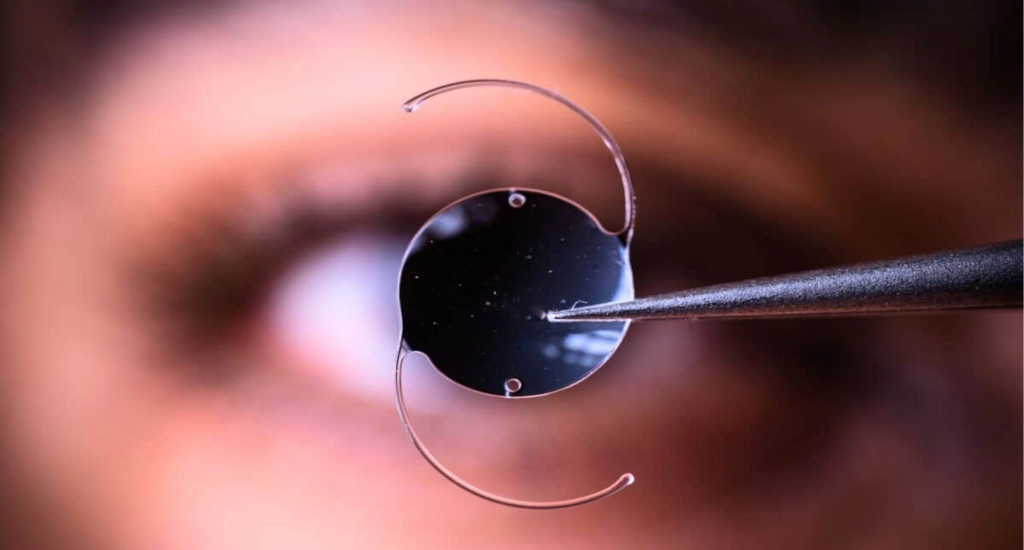
A tiny chip implanted at the back of the eye, paired with specialized glasses, is giving new sight to people who had resigned themselves to blindness. Science Corporation has begun rolling out the PRIMA photovoltaic retina implant across Europe after receiving CE mark approval earlier this year, making it the first commercially available device of its kind for advanced age-related macular degeneration.
How the Bionic Eye Works
PRIMA consists of a subretinal microarray about the size of a fat grain of rice, surgically placed beneath the retina during a roughly one-hour outpatient procedure. The implant has no external wires. Instead, it is powered and activated by near-infrared light projected from a camera-equipped pair of glasses worn by the patient. The glasses capture visual scenes and convert them into pulsed infrared patterns that the chip translates into electrical stimulation of surviving retinal cells, effectively bypassing the damaged photoreceptors that cause blindness in AMD.
Patients typically require training to interpret the new visual signals, which appear as patterns of light and dark. For many, the payoff has been life-changing.
Proven Results in Landmark Trial
In the PRIMAvera study — an open-label, multicenter trial published in the New England Journal of Medicine — 38 participants received implants and 32 completed 12 months of follow-up. Of those 32, 26 patients (81%) achieved a clinically meaningful improvement in visual acuity, defined as a gain of at least 0.2 logMAR from baseline. Using statistical imputation to account for the six participants with missing data, researchers estimated an 80% improvement rate across all implanted patients (95% confidence interval: 66–94; P<0.001).
Serious adverse events occurred in 19 of 38 participants, but most of the early post-operative complications resolved within two months. Peripheral vision remained stable after implantation.
The study, led by Frank G. Holz and colleagues, was published online in October 2025 and appeared in the January 15, 2026 print issue of the New England Journal of Medicine.
From Neuralink Roots to Vision Restoration
Science Corporation was founded by Max Hodak, who previously cofounded and served as president of Neuralink, the brain-computer interface company established by Elon Musk. Hodak left Neuralink in 2021 to create Science Corp with a mission to merge silicon electronics with biological systems — but with a deliberate business strategy: first build a sustainable commercial product in vision restoration, then use those revenues to fund more ambitious bio-hybrid projects.
The company accelerated its vision program in April 2024 by acquiring the intellectual property and clinical assets of Pixium Vision, the French firm that originally developed PRIMA. That acquisition gave Science Corp control over three ongoing late-stage clinical trials and the underlying platform technology.
Commercial Rollout and Cost
Science Corp is starting its European launch in Germany, where the first commercial implant is scheduled for August. Teams are negotiating reimbursement models with national health systems, as the device is expected to cost hundreds of thousands of dollars per unit. According to company statements reported by Bloomberg and industry outlets, Science Corp expects to implant dozens of patients in 2026 and roughly 200 in 2027.
“We’re focused on establishing payment arrangements in different countries,” Hodak said. “This is the first device from a U.S. brain-implant company to be made widely available to patients — and it’s a stepping stone to our broader mission.”
U.S. Pathway and Next-Generation Plans
While PRIMA is now on the market in Europe, Science Corp has also submitted its data to the U.S. Food and Drug Administration and is pursuing an accelerated pathway for rare forms of blindness. The company previously received an orphan device designation from the FDA’s Office of Orphan Products Development, which could streamline future approvals.
Looking ahead, Science Corp is developing upgraded versions of both the implant and the glasses, aiming to shrink the external hardware toward the form factor of consumer augmented-reality eyewear — though medical requirements for power and processing remain higher than those of consumer devices.
Beyond the retina, the company is partnering with Dr. Murat Günel, chair of Neurosurgery at Yale School of Medicine, to prepare human trials of a direct brain-implanted bio-hybrid sensor — a step toward restoring vision even in cases where the optic nerve or retina is too damaged for a retinal prosthesis.
A New Chapter for AMD Patients
For the estimated 5 million people worldwide living with geographic atrophy — the advanced, irreversible form of AMD — PRIMA represents the first implantable option to restore functional central vision. As one clinical-trial participant told researchers after years unable to read or recognize faces: “I can now read books, do crossword puzzles, and see my grandchildren’s expressions.”
With Europe’s rollout underway and U.S. approval on the horizon, Science Corp’s bionic eye is moving from experimental frontier to real-world therapy — and opening a new chapter in the convergence of neuroscience, electronics, and medicine.
Source: OlharDigital
 Buy me a Ko-fi
Support this blog ❤️



looking to find a location in North America that will be offering this implant. My husband has dry macular degeneration.
don’t expect good things out of the U.S.
Your best hope is Canada or Mexico.