
As a technology and environment columnist, I often say that humanity is now living in a New Era of Adaptation. If a decade ago we were mainly debating how to generate clean energy to slow global warming, today the frontier has shifted: we are asking how to use that very infrastructure to heal the scars we’ve already left on the planet.
The most striking example of this transformation is unfolding on the Tibetan Plateau in China. What began as a massive energy infrastructure project in the Talatan Desert has, almost by accident, become one of the world’s largest geoengineering experiments.
The Talatan Effect: Physics Meets Restoration
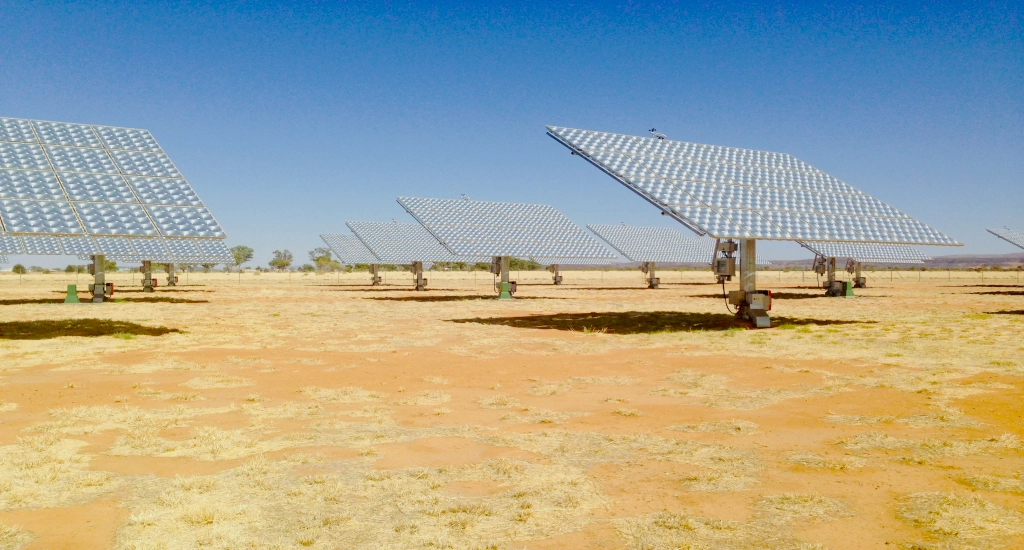
The Gonghe Photovoltaic Park is not just a power plant; it’s a 17,000-megawatt hub covering an area comparable to Singapore. But the real innovation isn’t only in the silicon cells—it’s in how the park is altering the local microclimate.
By blanketing the desert with millions of solar panels, the surface’s radiative balance has shifted. The panels cast constant shadows, lowering soil temperatures and reducing water evaporation. Field data reveal astonishing results:
- A 41.2% reduction in average wind speed, acting as a physical barrier against erosion.
- A 32% increase in soil moisture at 20 cm depth.
- The dew miracle: At night, the panels cool rapidly, causing atmospheric moisture to condense on their glass surfaces. By morning, this dew trickles down, irrigating the soil at the base of each structure.
The result? The desert is turning into pasture. Vegetation has grown so vigorously that companies had to raise the height of the panels (from 50 cm to 1.8 m) to allow “photovoltaic sheep” to roam and naturally manage the grass. It’s an unprecedented symbiosis of technology and traditional pastoralism, where infrared drones and QR-coded tags monitor the flock’s health while the sheep prevent fires by grazing.
A Global Trend?
China isn’t alone. In the U.S., the Gemini Solar Project in the Mojave Desert uses bifacial panels that track the sun to maximize energy output while striving to preserve local ecosystem functions. In Morocco, the Noor Ouarzazate complex powers over two million people, using mirrors to concentrate heat in molten salts, generating electricity for up to seven hours after sunset.
Scientists are now modeling even bolder scenarios. Covering just 20% of the Sahara with solar panels could, in theory, generate enough energy to power the entire world. But here’s the caveat I always emphasize: the climate system is interconnected. Simulations suggest that dark solar panels absorbing more heat than reflective sand could shift monsoon patterns and even trigger droughts in the Amazon through atmospheric “teleconnections.”
The Promise of “Eco-Voltaics”
When properly designed, these mega solar parks offer a new paradigm—“agrivoltaics” or “ecovoltaics”—with triple benefits:
- Food Security: Panel shade reduces water stress for crops in arid regions, boosting yields for drought-resistant plants like Astragalus.
- Energy Efficiency: Plants transpiring beneath the panels cool the air, improving the performance of solar cells, which lose efficiency in extreme heat.
- Soil Restoration: Lower wind speeds reduce erosion, allowing essential microorganisms to return and rebuild soil health.
In short, solar farms are no longer just about generating electricity—they’re becoming tools for climate repair, turning deserts into oases and rewriting the rules of what “clean energy” can mean. But as we “hack” the climate, we must proceed with humility, knowing that every intervention can ripple across the planet in unexpected ways.
Source: Canaltech
 Buy me a Ko-fi
Support this blog ❤️