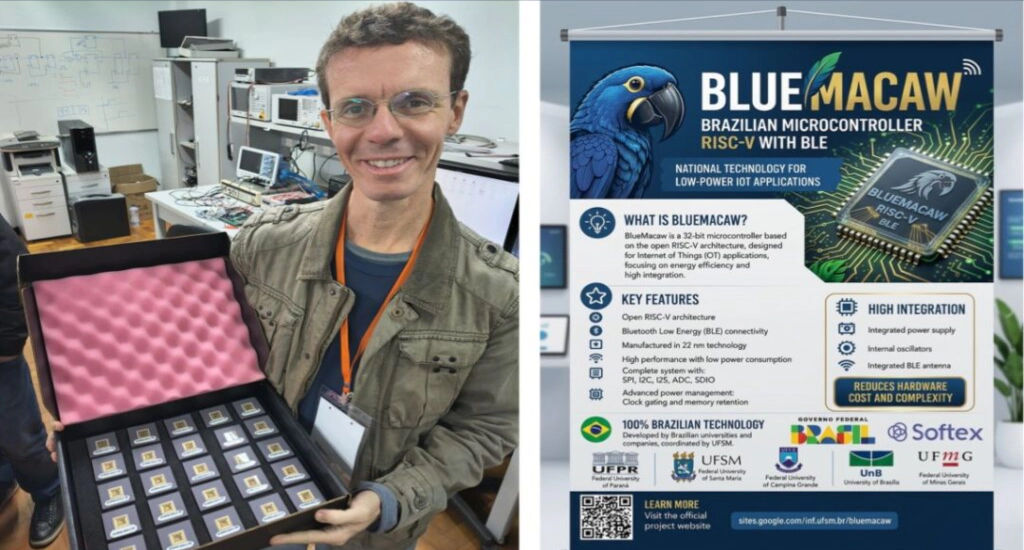
Belo Horizonte, Brazil — The first prototypes of Brazil’s homegrown 32-bit microcontroller, the u32BR codenamed BlueMacaw, have arrived at the Compilers Laboratory of the Department of Computer Science (DCC) at the Federal University of Minas Gerais (UFMG), signaling a major leap forward for the country’s semiconductor ambitions.
Developed on the open RISC-V architecture, BlueMacaw avoids proprietary licensing constraints and gives Brazilian engineers full control over the design stack. The chip targets Internet of Things (IoT) applications — from environmental sensors and smart-home devices to industrial controllers and urban infrastructure — where compact size, versatility, and minimal power draw are essential.
Fabricated using a 22-nanometer process at TSMC in Taiwan, the microcontroller packs 512 kB of memory, integrated Bluetooth Low Energy (BLE) connectivity with an on-chip antenna, and a full suite of peripherals including SPI, I²C, I²S, ADC, and SDIO. Advanced power-management features such as transparent clock switching and memory retention modes enable exceptional energy efficiency, making the chip suitable for battery-powered devices that must operate for months or years between charges.
Beyond the silicon, the project delivers a complete software development kit built by students at the Federal Center for Technological Education of Minas Gerais (CEFET-MG) and UFMG’s DCC, under the supervision of Professors Andrei Rimsa and Fernando Pereira. The toolkit includes compilers, libraries, and drivers that let developers bring up applications quickly on the new hardware.
Professor Fernando Pereira described the prototype delivery as a watershed moment: “This result shows that it’s possible to develop both the hardware and software of a technology of this scale in Brazil, training professionals and strengthening the country’s technological autonomy.”
BlueMacaw is the product of a five-university consortium led by the Federal University of Santa Maria (UFSM) through Professor João Batista Martins and its Microelectronics Group (GMicro), with participation from UFMG, the University of Brasília (UnB), the Federal University of Campina Grande (UFCG), and the Federal University of Paraná (UFPR). Industry partners — Intral, TecnoFlex, Exatron, Novus, and FKS — round out the collaboration. Chip packaging is being handled by Belgium’s imec innovation hub, while validation and block-level testing occur at UFSM.
The initiative is funded by the Ministry of Science, Technology, and Innovation (MCTI) through Softex, the national association for software and IT services. An official project portal now hosts technical documentation, tutorials, and the open-source SDK to accelerate adoption by Brazilian research groups and companies.
With physical prototypes in the lab, the next phase will focus on validation, benchmarking, and pilot deployments across IoT and edge-AI use cases — positioning Brazil to reduce its dependence on imported microcontrollers and compete in a market projected to grow steadily through the next decade.
 Buy me a Ko-fi
Support this blog ❤️