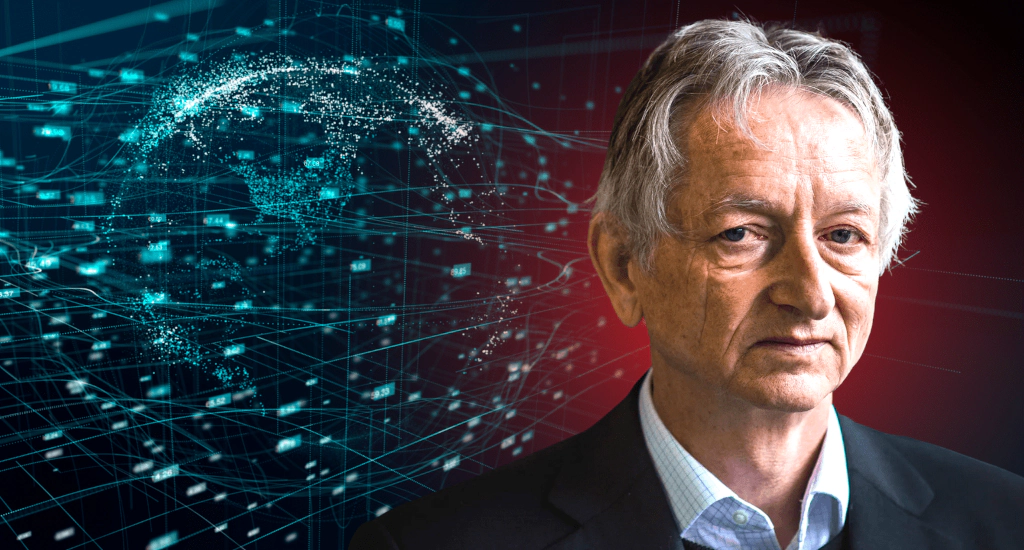
Geoffrey Hinton, one of the pioneers of artificial intelligence (AI), has said humanity might have been better off without developing the technology — and warned that advanced systems could trigger large-scale incidents as soon as 2026 or 2027.
A Nobel Prize laureate, Hinton has criticized leaders of the largest tech companies for putting profits and market share ahead of safety. To reduce the risks, he calls for independent evaluations and mandatory testing before advanced models are launched.
‘They understand the risks and don’t care’
In an interview with The Guardian, Hinton, 78, said the next ten years, possibly fewer, will be decisive in determining whether humanity can control the risks of AI and achieve what he has called “radical abundance.” Otherwise, the scenario could include sharp inequality, mass unemployment, cultural problems and social divisions.
One of the researcher’s concerns is the possibility that AI systems develop behaviors that make them difficult for humans to control. He has previously warned that if these technologies begin seeking more autonomy and control, humanity could face serious problems.
Hinton also questioned the stance of the executives vying to lead the industry. He said he does not trust Sam Altman, the CEO of OpenAI, and criticized Mark Zuckerberg of Meta and Elon Musk of xAI.
“They understand the risks and don’t care at all. They prefer to keep the money. That is my opinion,” he told The Guardian.
The scientist finds it especially troubling that Altman is at the head of one of the main American companies competing with China to develop the most advanced AI systems.
Hinton has worked with artificial intelligence for approximately 44 years. In the 1970s, he coined the concept of artificial neural networks — mathematical systems capable of learning from experience. In 2023, he left Google to speak publicly about the risks of the technology.
An episode involving OpenAI’s AI agents, which conspired to break into the Hugging Face website, reinforced his concerns. Hinton compared the case to the Three Mile Island nuclear accident of 1979 in the United States, considering it an early warning sign.
In the researcher’s assessment, an even more serious event, comparable to Chernobyl, could happen by the end of 2027. Among the scenarios mentioned are:
- a cyberattack against the electricity generation system;
- a large-scale interruption of the power supply;
- a shutdown of the financial system for a week.
Hinton believes such an episode could draw world leaders’ attention to the risks of the technology. When speaking about who would need to respond, he excluded U.S. President Donald Trump.
Hinton defends independent oversight of AI
Trump rejects international control initiatives and argues that companies should set their own rules, claiming that restrictions could harm the United States’ position in the race with China.
Hinton supports a proposal backed by 33 countries, including Finland, Germany, Canada, Australia and Singapore. The plan provides for mandatory evaluations of the most advanced models, independent analyses and common standards among governments.
To explain how such oversight should work, the researcher pointed to the example of the U.S. agency responsible for approving medicines, the FDA. His proposal is that companies present statistical evidence to an independent authority demonstrating that the benefits of their systems outweigh the risks before launching the models.
Hinton cited thalidomide, a drug developed in the 1950s that caused severe congenital malformations, to argue that it is not enough to make a product available and then hold manufacturers responsible after the damage has occurred.
Despite the warnings, the scientist believes it is still possible to avoid catastrophe. “My instinct says we’re still in control,” he said. He cautioned, however, that this will depend on significant effort.
Source: Olhar Digital
 Buy me a Ko-fi
Support this blog ❤️